Featured
The projects and research showcased here represent my commitment to exploring how technology can address pressing challenges in sustainability, public safety, health, education, and community connection—each endeavor reflecting my belief that the best innovations happen when we combine technical excellence with deep empathy for the people and environments we're designing for.
Denver Mayor's Office · 2024 – Present
Give5 Mile High
Connecting Denver residents with volunteer work.
Project Manager and Lead Designer/Developer. Led a 15-month build and a pivot from mobile app to web, removing the app-store barrier between residents and their first shift.
See more →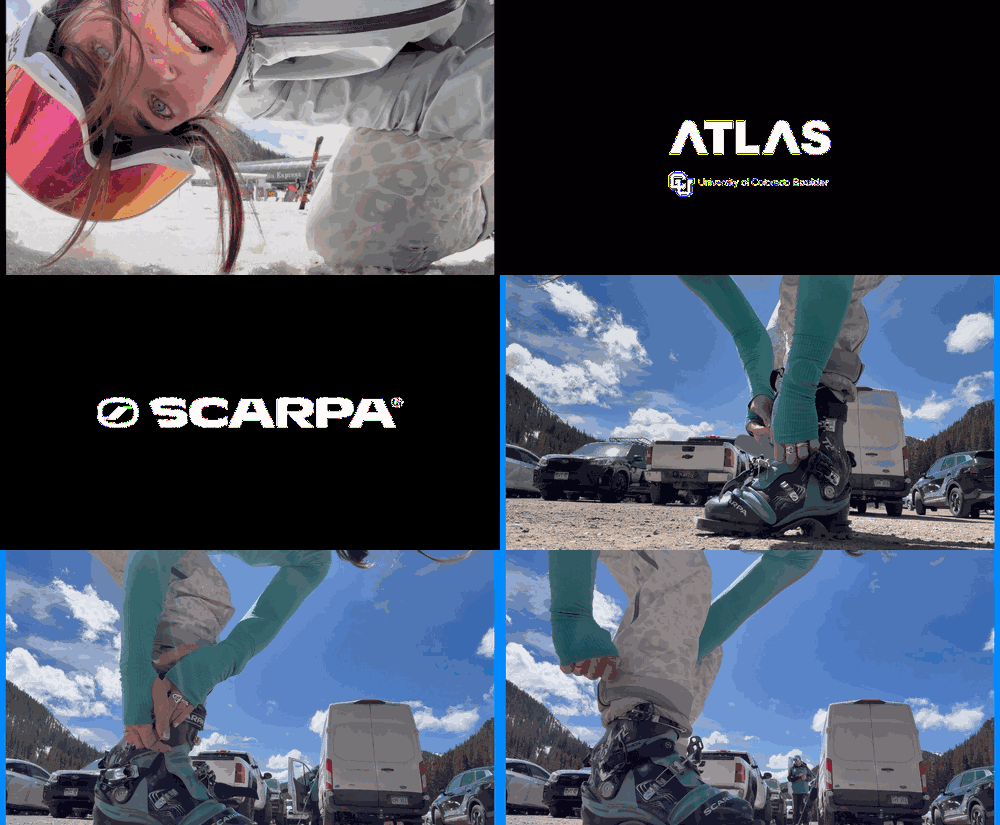
SCARPA North America · Spring 2026
SCARPA Boot Fitter
Connecting skiers with the boot that actually fits.
iOS app in Swift and ARKit that scans a foot with LiDAR and matches it to SCARPA's full boot catalog.
See more →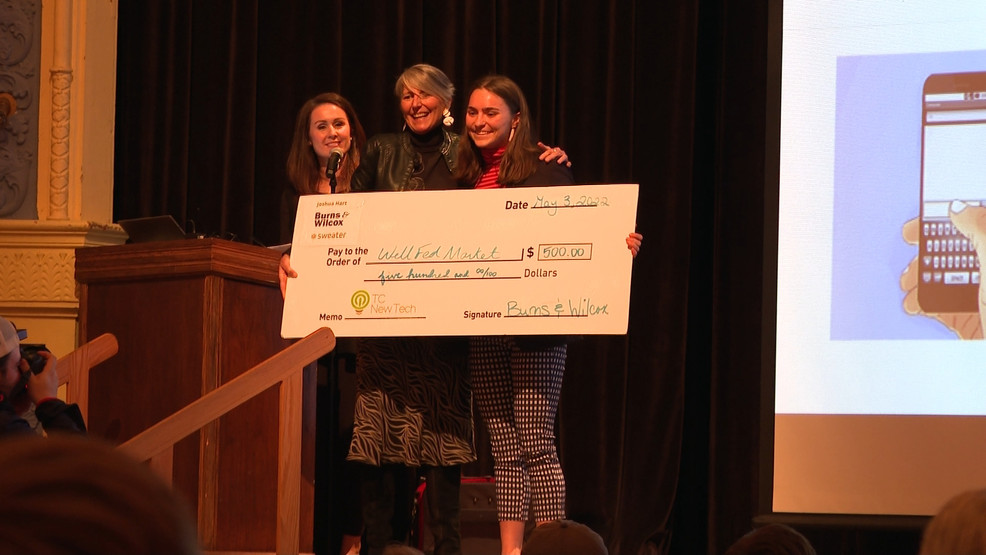
Founder · 2021 – 2024
Wellfed Market
Connecting students with excess campus food.
Secured funding for, built, and deployed an iOS food-sharing app with local nonprofits and student groups.
See more →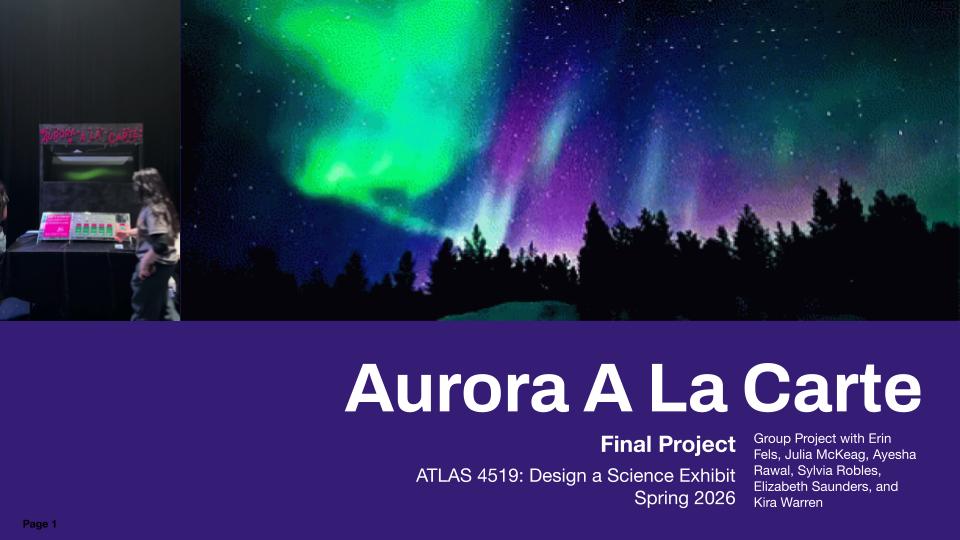
CU Boulder's Fiske Planetarium · Spring 2026
Aurora A La Carte
Connecting museum visitors with the physics of the aurora borealis.
Built a tangible dashboard and real-time Pepper's Ghost projection so visitors "cook up" their own aurora and leave with a recipe card of their creation.
See more →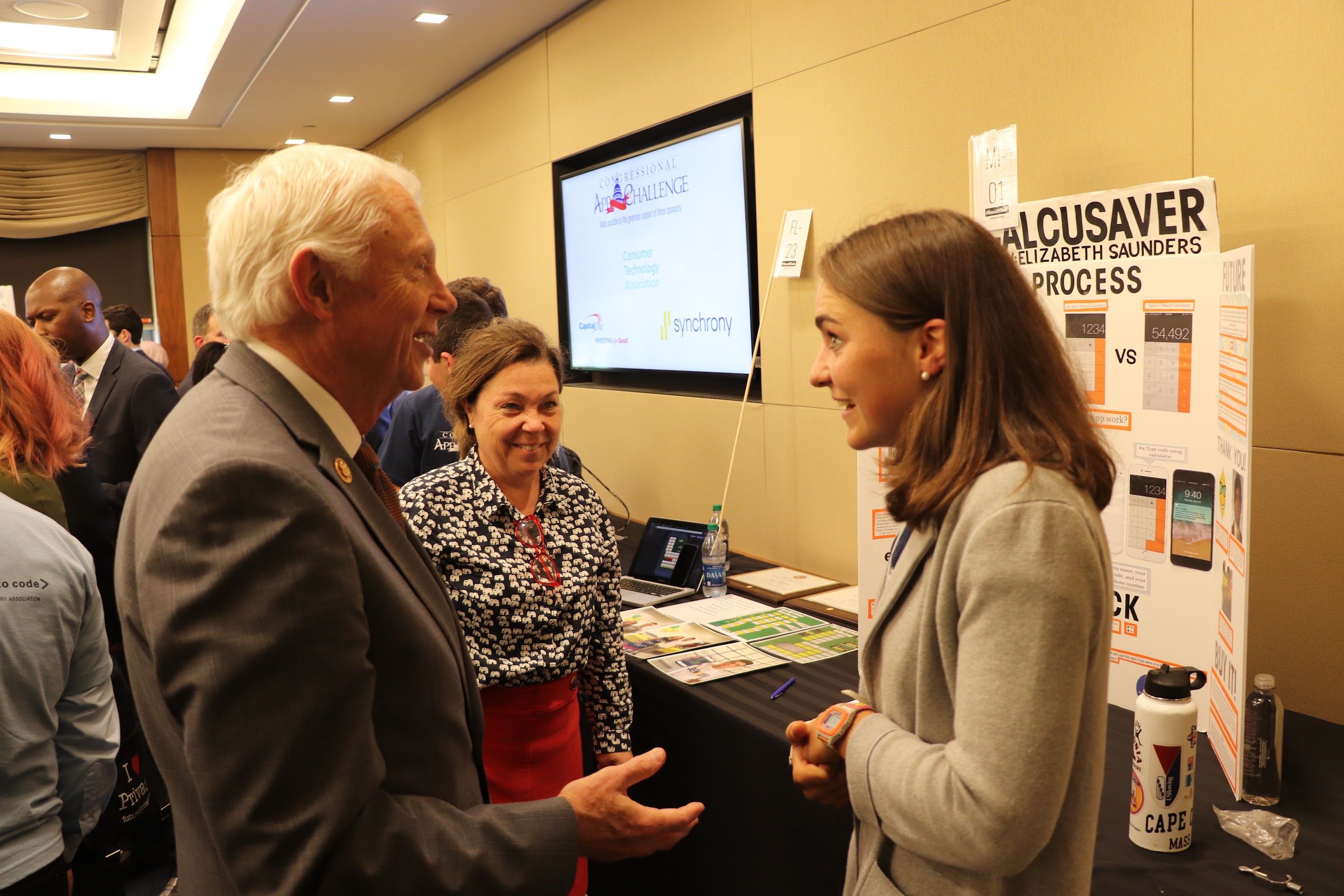
Where it started · 2017
CalcuSaver
At 15, I built a calculator app that discreetly connects people with help.
Won the Congressional App Challenge and was presented to members of Congress at the Library of Congress.
See More →Archive
Give 5 Mile High
November 2024 - Present
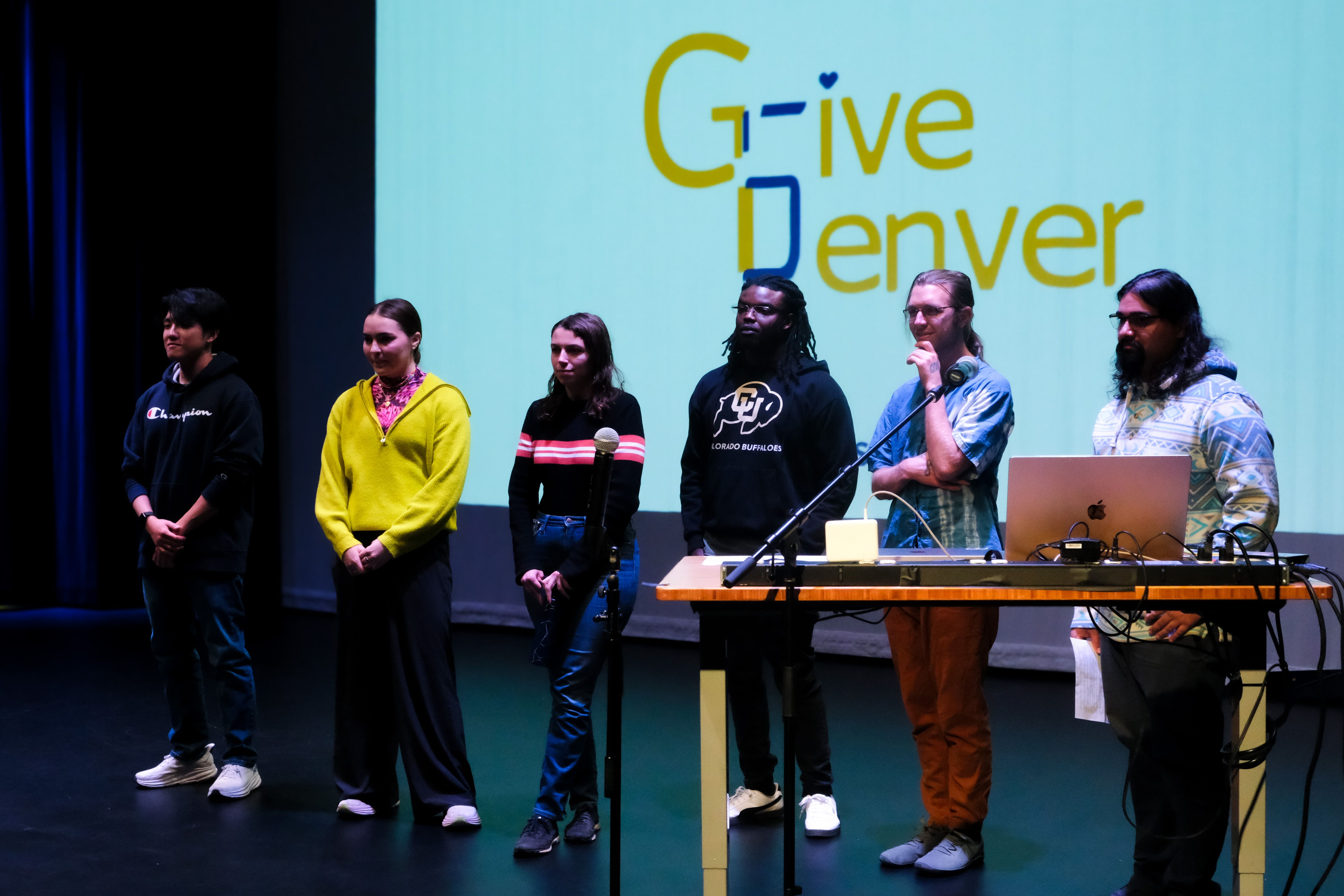
See ProjectGive5 Mile High is a citywide volunteer initiative led by First Lady of Denver Courtney Johnston and the Mayor's Office outreach team. In partnership with Aaron Neyer and Shawn Duncan, I led the development of a responsive web platform connecting Denverites with volunteer opportunities while enabling seamless hour tracking and incentive redemption. Elected by the team as Project Manager, I oversaw the 15-month development lifecycle—from initial conception through design, development, and launch preparation—including a strategic pivot from mobile app to web platform that eliminated app store barriers and enabled SEO-optimized volunteer discovery.
As Project Manager and Lead Designer/Developer, I coordinated weekly team meetings, established project milestones, and designed the complete UI/UX system featuring Denver's signature Blue, Bold Red, and Clean White branding. I developed the responsive web architecture including user authentication, event discovery with intelligent filtering, hour tracking with check-in validation, an incentives redemption system, and a comprehensive nonprofit admin dashboard.
The platform features a dual-sided architecture serving both volunteers and nonprofit administrators through browser-based tools, eliminating dependencies on app stores while providing modern management capabilities. I successfully guided the team through the mobile-to-web pivot while maintaining project momentum, established a scalable component architecture and design system, and completed security audits and WCAG accessibility improvements. The responsive design works seamlessly across desktop, tablet, and mobile browsers with integrated analytics for tracking user behavior and engagement.
Give5 Mile High strengthens Denver's volunteer ecosystem by removing friction from the volunteer experience and empowering nonprofits with accessible management tools. The platform incentivizes civic engagement through a rewarding, trackable volunteer journey, positioning Denver as a leader in technology-enabled community service. With launch preparation complete and comprehensive support materials developed, the project demonstrates how thoughtful technical leadership and user-centered design can drive meaningful social impact.
the DL
May 2026 - Present
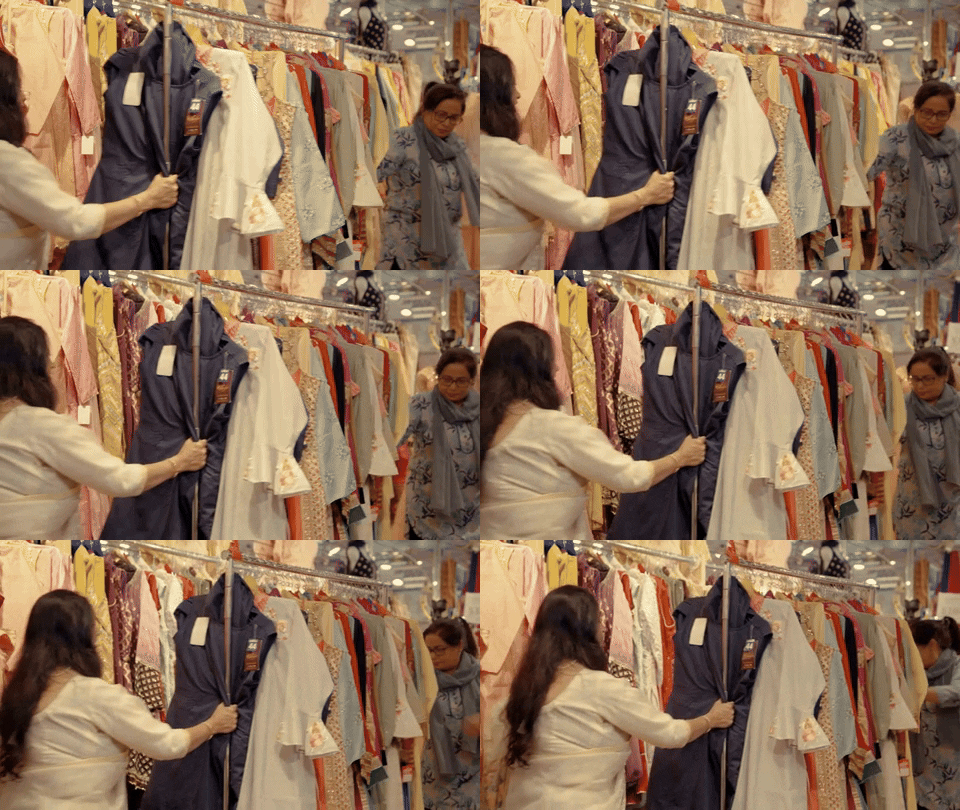
See ProjectThe DL is a platform that brings local thrift store inventory online—making the best finds in your city actually findable. Shoppers can browse, filter, and buy (or hold) items from real local stores without having to walk in blind. Stores list for free; shoppers get the hidden gems. No mystery, no middleman.
Currently: building and launching the prototype—product concept, branding, web development, and go-to-market strategy. Currently in active partner development, recruiting consignment and thrift stores to join the marketplace.
Rise Against Suicide Online Toolkit for Therapists
May 2026 - Present
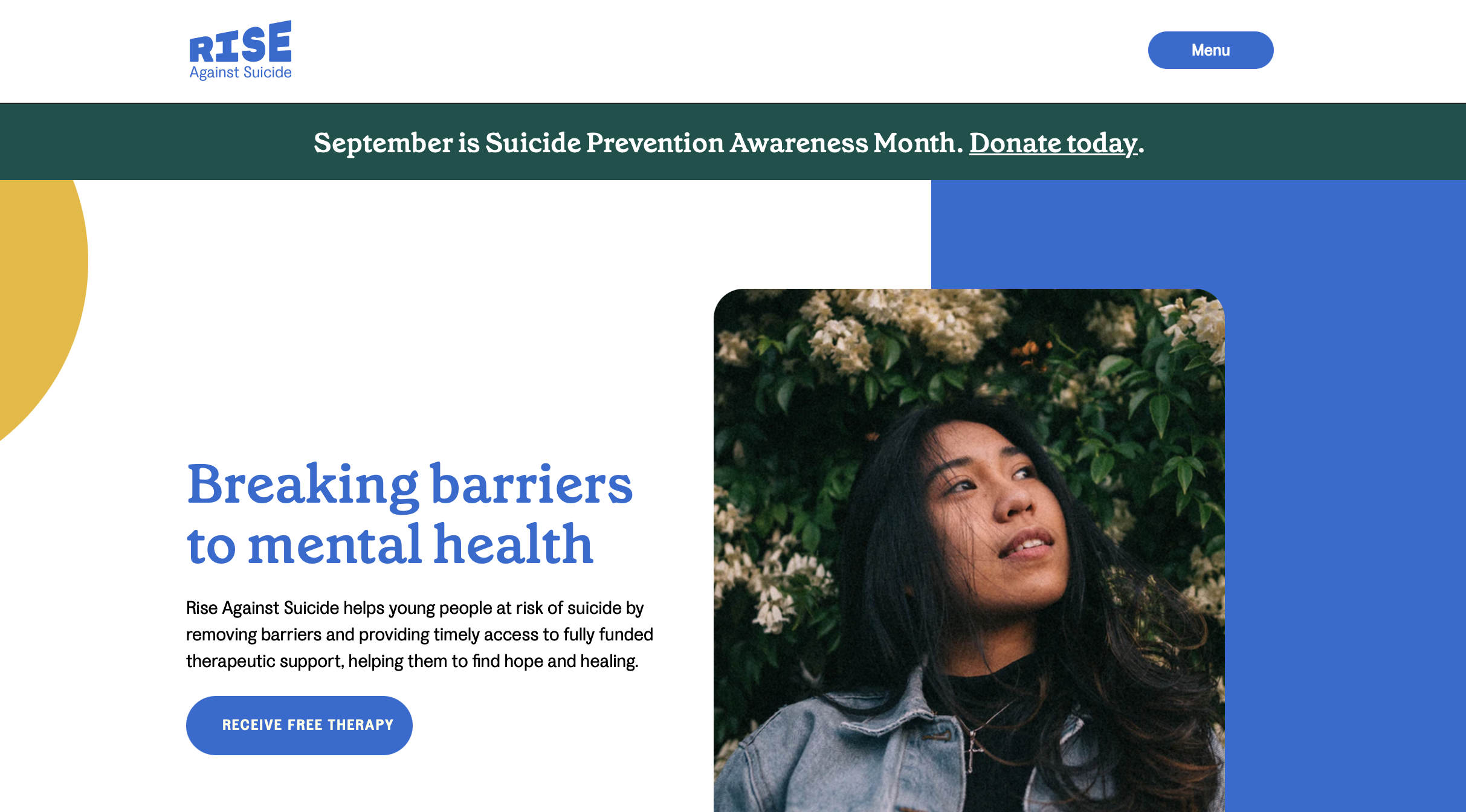
See ProjectPitched and won the bid to design and develop an online therapist toolkit for Dr. Tamar Kodish (Assistant Professor in the Department of Psychology and Neuroscience at CU Boulder), in partnership with Rise Against Suicide — a Boulder, CO-based nonprofit serving the Colorado Front Range that helps young people at risk of suicide by removing barriers and providing timely access to fully funded therapeutic support, helping them find hope and healing. Ultimately, expanding mental health resources and access to at-risk youth.
This bid brought me on as a Temporary Researcher at CU Boulder, Boulder, Colorado. I support the design, development, testing, launch, and maintenance of the toolkit, translating findings from therapist co-design interviews and focus groups into an accessible, user-friendly digital resource for therapists providing care to youth experiencing suicidal ideation and behavior.
I work closely with Dr. Kodish, the research team, Rise Against Suicide, and therapist end-users to shape the toolkit's structure, navigation, content organization, and functionality.
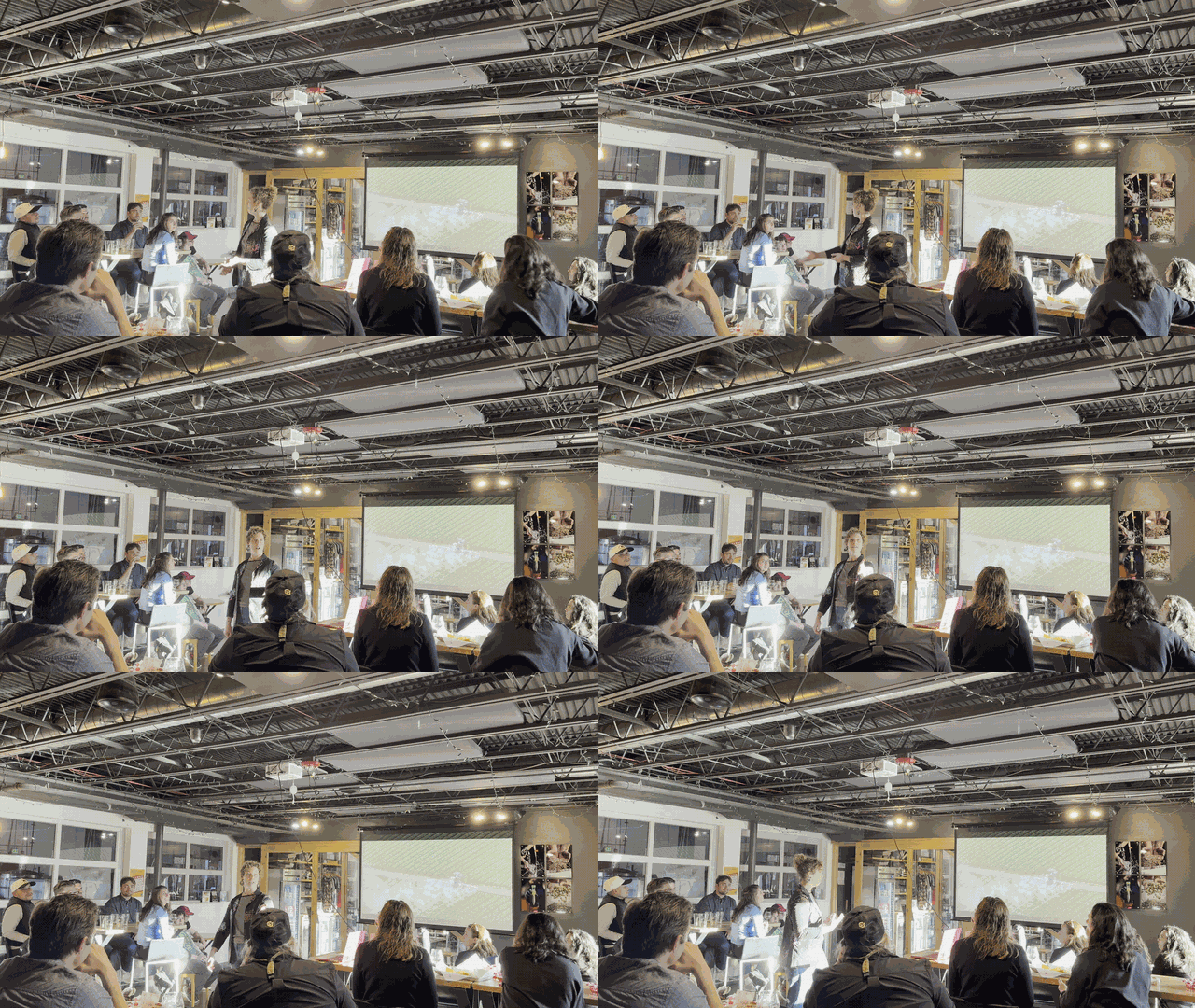
Sustainability on Tap Event #5
Hosted on May 20, 2026
See Day of SlidesTheme: "Built by Nature: Living Systems, From Ecosystems to Buildings"
As a student researcher at CU Boulder's Sustainability Research Initiative, I organized the May edition of "Sustainability on Tap" — my final event in the series before passing the torch to a colleague. The evening brought together two researchers whose work sits at a fascinating and underexplored frontier: the chemistry of life itself, and what it might mean for how we build our world.
The night opened with Dr. Danielle Beatty, a postdoctoral researcher in CU Boulder's Civil, Environmental, and Architectural Engineering Department, who delivered a talk titled "Coccolitho-what?: Growing Minerals for Sustainable Cement Production." Dani completed her PhD in Materials Science and Engineering at CU Boulder in May 2025 and has continued her research ever since — work that sits at the intersection of biology, materials science, and civil engineering, with a focus on making building materials more sustainable. She was an instant audience favorite: approachable, sharp, and clearly someone who can hold a conversation about coccolith biomineralization and competition cooking shows in the same breath.
Dr. Eve-Lyn Hinckley followed with "A Long-Ignored Element Has its Big Moment," a talk drawn from her NSF-, USDA-, and National Geographic Society–funded research on the global sulfur cycle. A Stanford-trained geoscientist with a BA from Middlebury, Dr. Hinckley studies how human activities are reshaping the elemental cycles that underlie all life — and what those shifts mean for human welfare in return. Her work using stable and radioisotopes to trace sulfur transformations in agricultural systems and the broader environment gave the audience a window into a planet-scale story hiding in plain sight.
Together, the two talks sparked exactly the kind of conversation "Sustainability on Tap" is designed to create — casual enough for a Wednesday night at a brewery, substantive enough to stick with you afterward.
This was my final event to organize for SRI — and it went out on a high note. The May edition exceeded every expectation: strong turnout, genuinely curious attendees, and two speakers who made complex science feel like dinner conversation. It was the kind of evening that validates the whole premise of the series. Because of that success, I'm confident passing the baton to Xochitl Ryan, who will carry "Sustainability on Tap" forward. The next edition is already on the calendar for June 17, 2026 with Kaitlin Urso and Dr. Shelly Miller with a theme of air quality impacts. The series is in good hands, and I can't wait to see where they take it.
SCARPA Boot Fitter
Submitted April 27, 2026
See Project See Video See PaperThe SCARPA Boot Fitter app, made for the ATLAS Social Impact Practicum, is an iOS application that uses LiDAR scanning technology to capture precise 3D measurements of a user's foot and recommend the best-fitting SCARPA ski boot from the brand's full catalog. The project addresses a real and frustrating problem in the ski industry: boot fitting is highly technical, deeply personal, and often inaccessible — most skiers end up in the wrong boot, leading to pain, injury, and unnecessary returns. By partnering with SCARPA North America, the app brings expert-level fitting guidance directly to the consumer, with meaningful impact across three dimensions: improved skier safety through better-fitting equipment, reduced environmental emissions from fewer return and exchange shipments, and richer foot geometry data that feeds back to SCARPA's development team to inform more inclusive boot designs for underrepresented foot shapes.
Built in Swift using ARKit, the app guides users through a four-phase scanning flow — setup, capture, reconstruction, and measurement — and maps the resulting foot geometry against SCARPA's boot specifications to surface a personalized recommendation. The project sits at the intersection of spatial computing, consumer health technology, and the outdoor industry, demonstrating how emerging hardware capabilities can drive both individual outcomes and systemic change.
Aurora A La Carte
Submitted April 20, 2026
Try It: Create an Aurora See Video See Project See CU Craft LabWhat if learning about the physics of the aurora borealis felt less like a lecture and more like cooking? Aurora A La Carte is a hands-on museum exhibit designed for elementary-aged visitors, built for CU Boulder's Fiske Planetarium as part of ATLS/CSCI 4519: Design a Science Exhibit — a course taught in collaboration with makers, scientists, and science communicators Eddie Goldstein, Ann Eisenberg, Wayne Seltzer, and Michael Banks. I built it alongside teammates Erin Fels, Julia McKeag, Ayesha Rawal, Sylvia Robles, and Kira Warren in Spring 2026.
Visitors step up to a tangible dashboard of sliders and buttons and "cook up" their own aurora — adjusting altitude, geomagnetic activity, light pollution, and proximity to the poles. Each combination drives a real-time Pepper's Ghost illusion projection, rendering a customized aurora in the air in front of them. They leave with a printed recipe card souvenir: their aurora, their conditions, their creation.
My role spanned science communication, research, and the interactive digital prototype. I translated the underlying atmospheric physics — charged solar particles funneling through Earth's magnetic poles, colliding with oxygen and nitrogen at varying altitudes to produce distinct colors — into an accessible, joyful experience that a seven-year-old could navigate intuitively. I built and iterated on the digital aurora simulation, incorporating feedback from teammates and instructors to make the projection more dynamic, organic, and responsive across the full range of input values.
The exhibit was tested at Fiske Planetarium and shown at the ATLAS Expo, with one guiding principle throughout: idiot-proof, unbreakable, and genuinely fun.
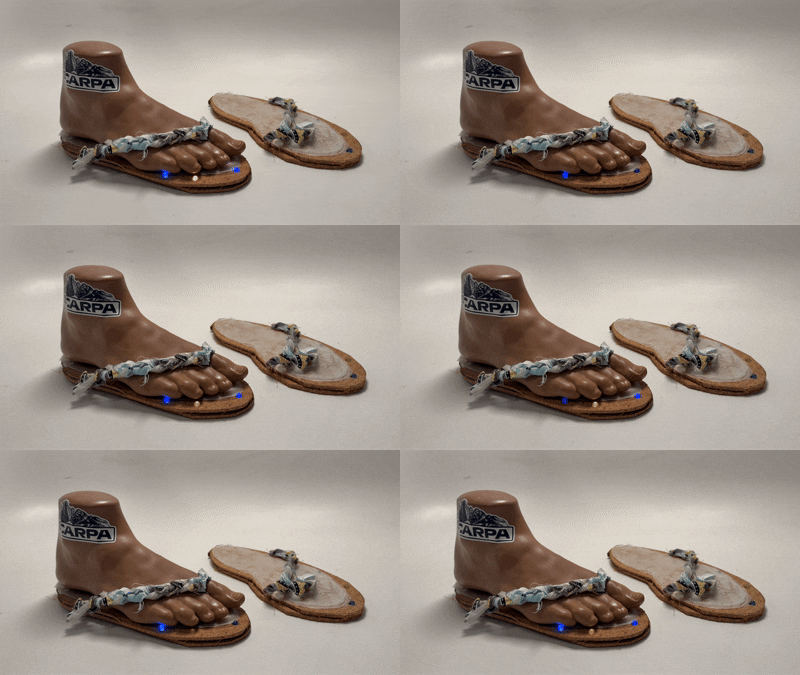
Twinkle Toe Flip Flops
Submitted April 20, 2026
See Project See VideoA wearable biodesign project developed with Rachel Diamond for ATLS 4201/5201: Biodesign (Spring 2026), exploring the intersection of sustainable materials and embedded electronics. Together, we designed and fabricated a pair of flip flops constructed from bioplastic layers — made from agar, glycerin, and water — poured into custom 3D-printed sole molds sized to fit. The soles layer bioplastic with cork for structural reinforcement, exploring compostable material combinations as an alternative to conventional synthetic footwear.
The "tangible interaction" element comes from embedded electronics: a Seeeduino Xiao microcontroller paired with a tilt sensor triggers LED lights when the wearer steps, creating a twinkle toes effect that responds to movement. Hardware assembly involved soldering, wire stripping, and iterative circuit testing.
The project required navigating real material constraints — early bioplastic batches came out too thin and wet, prompting formula iteration and process adjustments — making it as much an exercise in materials research and prototyping resilience as in design.
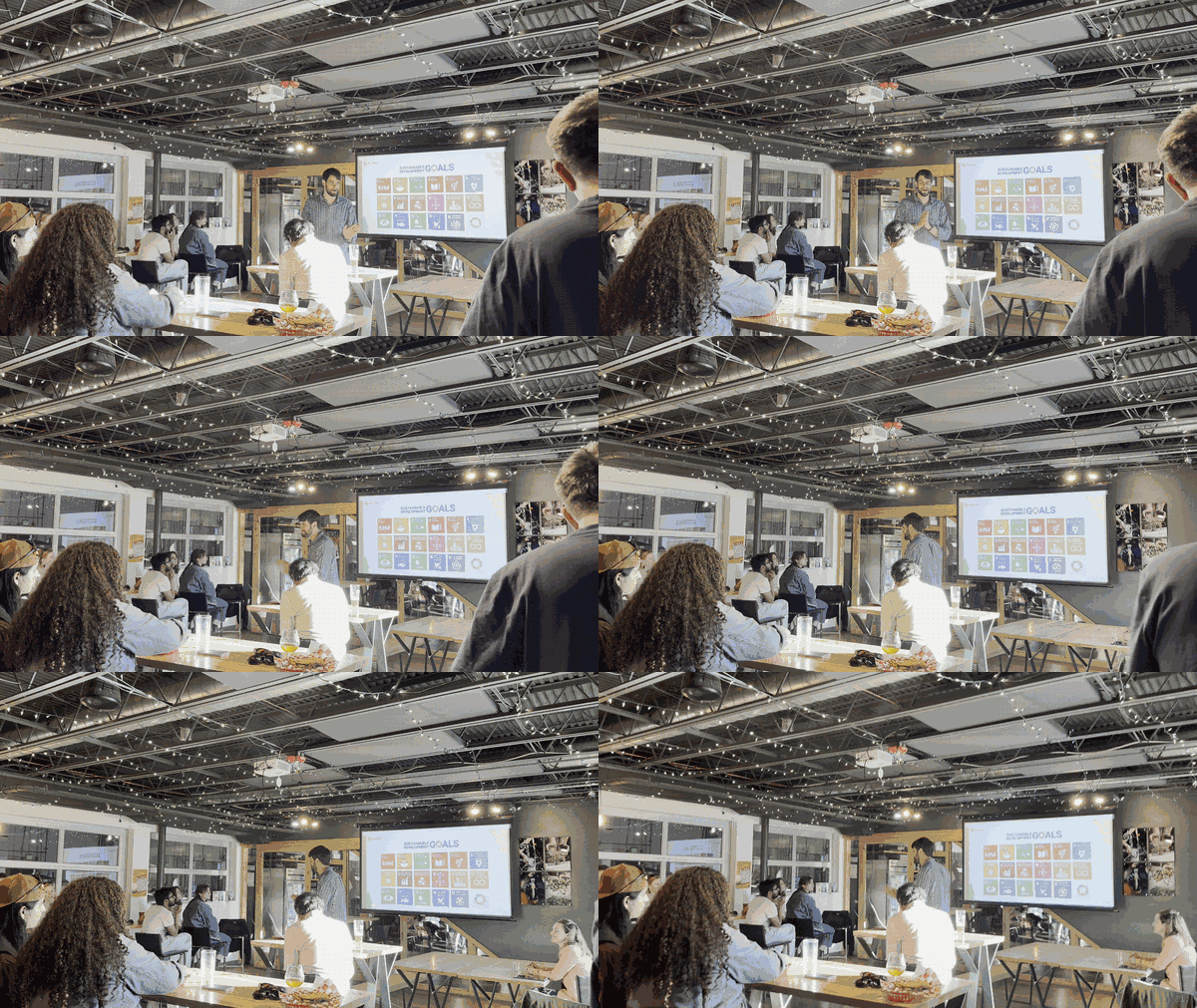
Sustainability on Tap Event #4
Hosted on April 15, 2026
See Day of SlidesTheme: "On the Map: AI, Policy, and a Fairer Future"
As a student researcher at CU Boulder's Sustainability Research Initiative, I led the organization of the April edition of "Sustainability on Tap," a community-centered event series designed to foster dialogue between university researchers and local Boulder residents. Working closely with SRI's director, Dr. Jane Zelikova, I managed the full operational execution of the event—from speaker curation to night-of logistics—at Upslope Brewing Company in Boulder, CO.
April's event brought together two researchers whose work examines the intersection of data, policy, and the transition to sustainable economies. Isaiah Lyons-Galante, a Ph.D. student in Environmental Studies at CU Boulder's Better Planet Lab, presented his work on high-resolution global mapping of wealth and poverty. Advised by Zia Mehrabi, Isaiah combines satellite imagery, crowd-sourced open data, and machine learning to understand where development investments yield the highest returns in the world's poorest regions—research shaped by six years working in solar energy access across East and West Africa with PowerGen. Dr. Srinivas "Chinnu" Parinandi, Associate Professor of Political Science at CU Boulder, brought a political economy lens to the evening, drawing on his NSF-funded research on renewable energy and electric vehicle policy. An author published in outlets including the American Journal of Political Science and Energy Policy, and with books from the University of Michigan Press and Cambridge University Press, Chinnu explored how policy shapes—and is shaped by—the clean energy transition. Together, the speakers sparked a rich conversation about the economic and political pathways toward a more equitable and sustainable world.
My responsibilities included identifying and inviting both speakers, coordinating with them ahead of the event to align on format and content, managing logistics with Upslope Brewing Company, and ensuring the evening ran smoothly from start to finish. The "science meets community happy hour" format kept the atmosphere casual and welcoming, lowering barriers to participation for researchers, practitioners, and community members alike.
Measuring Sustainability Workshop
Hosted on April 3, 2026
See Day of SlidesAs a student researcher at CU Boulder's Sustainability Research Initiative, I co-organized and facilitated a full-day workshop connecting researchers and graduate students around a shared challenge: developing scalable measurement approaches for climate and sustainability projects across Boulder County.
Hosted at Norlin Library's Center for Global British & Irish Studies, the event ran from morning through mid-afternoon and featured two keynote speakers — James Rattling Leaf and Katie Suding of the Colorado Buffalo Collective, and Tim Brodrick of the Boulder County Climate Office, whose office is directly funding one participant team with up to $100,000. I helped coordinate venue logistics, catering, and the full arc of programming alongside SRI Director Dr. Jane Zelikova, Research Analyst Xochitl Ryan, and CIRES Director of Access and Cultural Innovation Becca Edwards.
On the programming side, I helped orchestrate lightning talks and facilitated a structured afternoon in which participants brainstormed measurement ideas, engaged in Q&A with the funder, and then spent over two hours in collaborative proposal development. Focus areas included stream and riparian restoration, urban tree canopy expansion, biochar, agricultural soil health, and green infrastructure — project types where consistent, transferable measurement methodology remains an open problem.
The workshop exemplified the kind of work I find most meaningful: designing conditions where researchers can move from individual expertise toward collective, place-based impact — with real resources on the line.
Sustainability on Tap Event #3
Hosted on March 25, 2026
See Day of SlidesTheme: "Brewing Change: Food, Business, and a Healthier Planet"
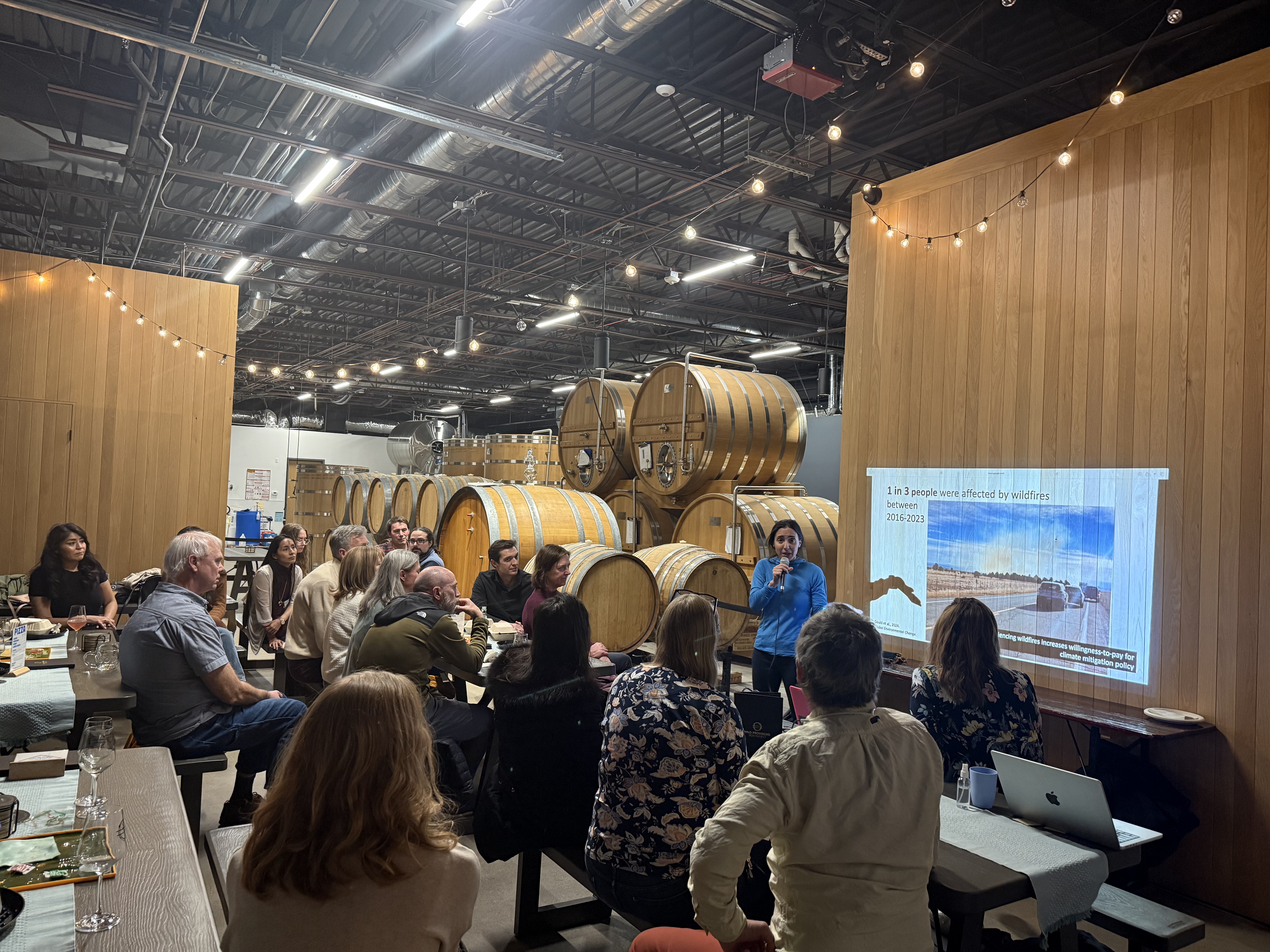
As a student researcher at CU Boulder's Sustainability Research Initiative, I led the organization of the March edition of "Sustainability on Tap," a community-centered event series designed to foster dialogue between university researchers and local Boulder residents. Working closely with SRI's director, Dr. Jane Zelikova, I managed the full operational execution of the event—from speaker curation to night-of logistics—at Wild Provisions Beer Project in Boulder, CO.
March's event explored the intersections of food systems, sustainability science, and entrepreneurship. I selected and coordinated two speakers whose work approached these themes from complementary angles. Carmen Pacheco spoke to the science, sustainability, and story behind one of the world's most beloved commodities—chocolate—tracing the journey from cacao to bar and the environmental and social dimensions embedded in that supply chain. Dr. Jeffrey York, drawing on his expertise in environmental entrepreneurship, explored how early-stage ideas become real-world impact, offering both researchers and community members a framework for thinking about sustainability-driven ventures. Together, they sparked a rich conversation about the roles that consumer choices, business innovation, and ecological awareness play in shaping more sustainable food systems.
My responsibilities included identifying and inviting both speakers, coordinating with them ahead of the event to align on format and content, managing logistics with Wild Provisions Beer Project, and ensuring the evening ran smoothly from start to finish—capped by a tour of the brewery led by General Manager Nate Scheidenhelm. The "science meets community happy hour" format kept the atmosphere casual and welcoming, lowering barriers to participation for researchers, practitioners, and community members alike.
Sustainability on Tap Event #2
Hosted on February 18, 2026
See Day of SlidesTheme: "Zoom In, Zoom Out: From Living Materials to a Changing Planet"
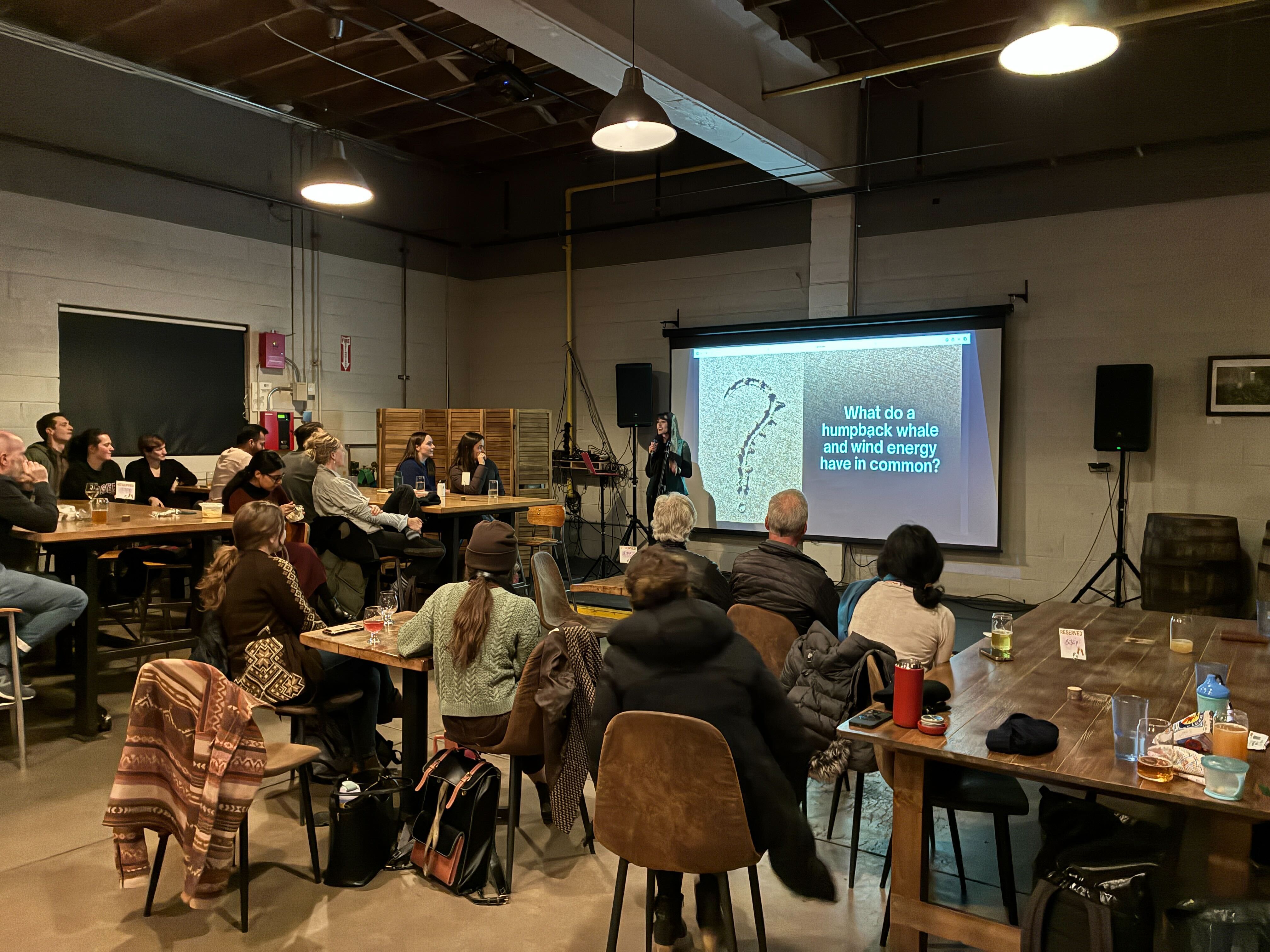
As a student researcher at CU Boulder's Sustainability Research Initiative, I led the organization of the February edition of "Sustainability on Tap," the second event in this ongoing community-centered series designed to foster dialogue between university researchers and local Boulder residents. Working closely with SRI's director, Dr. Jane Zelikova, I managed the full operational execution of the event—from speaker curation to night-of logistics—at Wild Provisions Beer Project, a craft brewery in Boulder, CO.
February's event brought together two researchers whose work sits at the intersection of sustainability, design, and data-driven resilience. Dr. Eldy Lazaro Vasquez, a Peruvian designer and postdoctoral researcher at UC Davis, spoke to her work in biodesign and interactive textiles—exploring how biomaterials can reshape the way we think about sustainable, on-body interfaces and design systems. Her doctorate from CU Boulder's own ATLAS Institute gave the conversation a local resonance, connecting her cutting-edge research back to the community where much of it was developed. Dr. Virginia Iglesias, Director of Earth Lab and Research Scientist at CIRES, brought a complementary perspective rooted in data and community impact—sharing how her team integrates satellite imagery, field observations, social media, and government records to advance actionable science around natural hazards and climate variability. Together, their presentations opened a conversation about sustainability from two distinct but connected angles: the materials we design with and the environments we must learn to live within.
My responsibilities included identifying and inviting both speakers, coordinating with them ahead of the event to align on format and content, managing logistics and AV setup with Wild Provisions Beer Project, and ensuring the evening ran smoothly from start to finish. The "science meets community happy hour" format kept the atmosphere casual and welcoming, lowering barriers to participation for researchers, practitioners, and community members alike.
This event reflects my broader commitment to making sustainability research accessible and relevant to everyday people—and to building the behind-the-scenes infrastructure that allows meaningful university-community exchange to happen.
Sustainability on Tap Event #1
Hosted on January 21, 2026
See Day of SlidesTheme: "Seeing Is Believing: How Perception and Story Shape Climate Action"
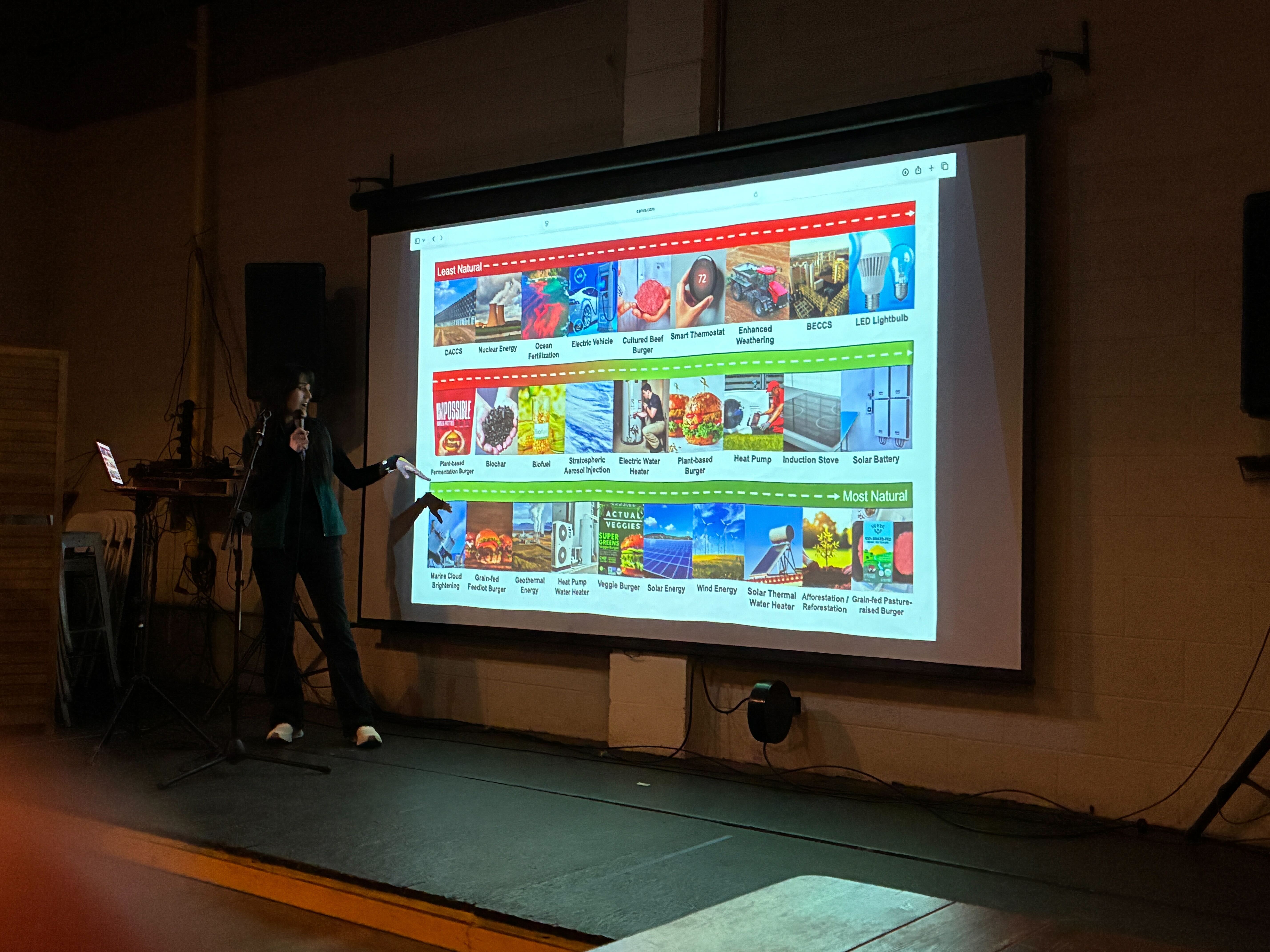
As a student researcher at CU Boulder's Sustainability Research Initiative, I helped launch "Sustainability on Tap" — a monthly community event series connecting university researchers with Boulder residents over good conversation and a drink. The goal is to build it into a recurring monthly program that gives SRI a consistent public presence in Boulder. Dr. Jane Zelikova, SRI's director, brought me on to get it off the ground, and I had full creative latitude to shape what it became.
For the January kickoff at the Rayback Collective, I built the event around a theme I found genuinely compelling: how media and psychology influence the way people engage with sustainability. I invited two speakers whose work approached it from different angles — Dr. Erin Espelie, a CU cinema professor, Editor in Chief of Natural History magazine, and co-director of the NEST Studio for the Arts, who works at the intersection of nonfiction film and environmental storytelling; and Dr. Sarah Gonzalez-Coffin, a recent CU Social Psychology PhD whose research focuses on climate communication and public attitudes toward energy infrastructure. The conversation between them was exactly what I'd hoped for — substantive but accessible, the kind of thing that doesn't usually happen outside a conference room.
My responsibilities included identifying and inviting both speakers, coordinating with them ahead of the event to align on format and content, managing AV setup and capacity logistics with the Rayback Collective, and ensuring the evening ran smoothly from start to finish. The "science meets community happy hour" format kept the atmosphere casual and welcoming, lowering barriers to participation for researchers, practitioners, and community members alike.
MeetingMaker
May 2023 - January 2026
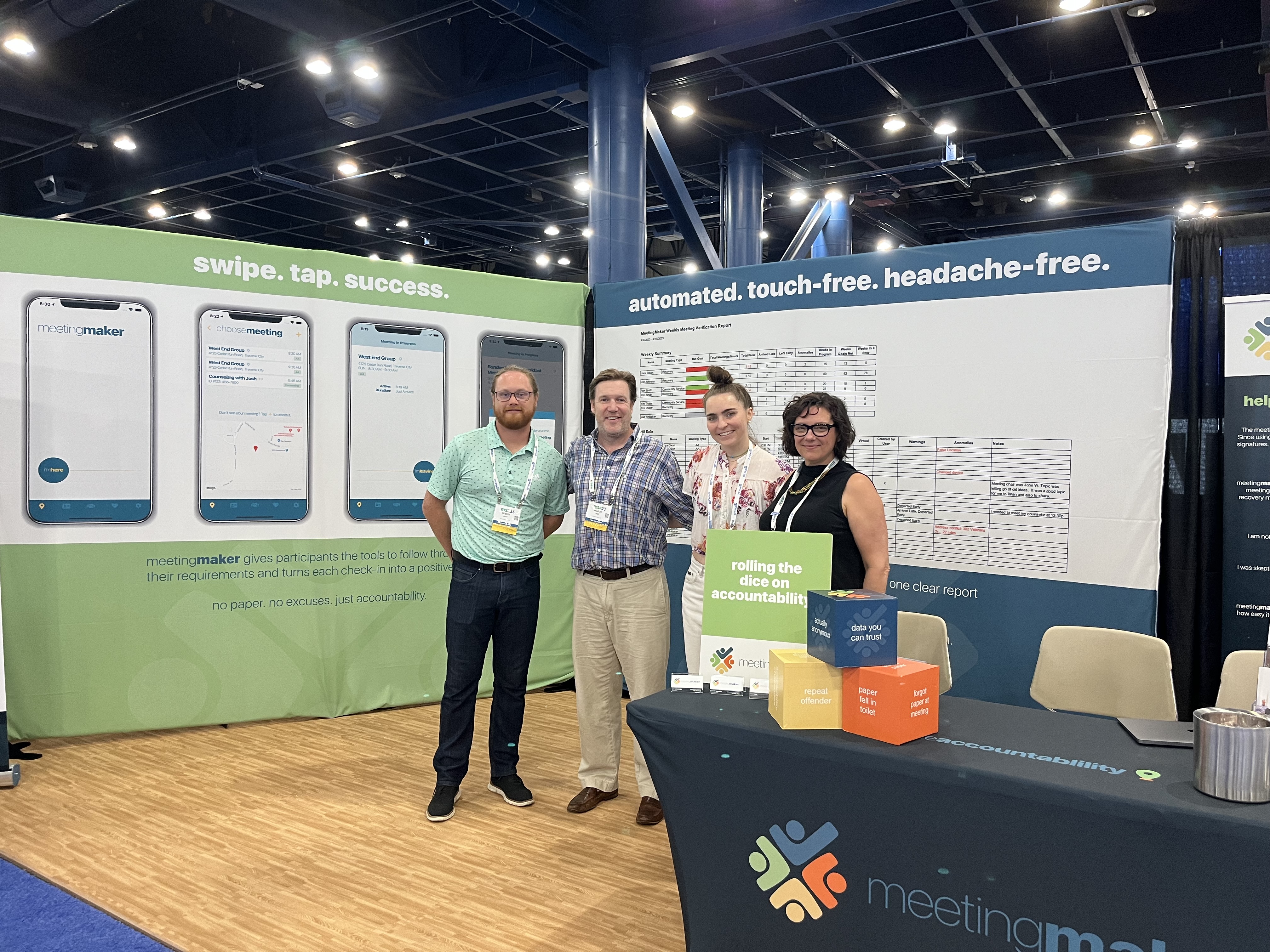
See ProjectJoined Jodie Schanhals as a development intern to help build the iOS/Android app, MeetingMaker. The app aims to help users discreetly check in and out of Alcoholics Anonymous meetings, creating a secure and accurate record of attendance for themselves and drug and treatment courts.
MeetingMaker is a user-friendly mobile app designed to help individuals discreetly check in and out of meetings, creating a secure and accurate record of attendance. This innovative tool is particularly beneficial for those needing to verify attendance at 12-step programs, community service, and other recovery-related meetings, although it can be utilized in various non-recovery contexts as well.
MeetingMaker empowers users to manage their meeting attendance goals effectively. The app also allows users to add contacts, enabling automatic sharing of attendance reports with anyone who needs them.
As a development intern for MeetingMaker, I collaborate on developing this innovative, impact-driven mobile app solution supporting addiction recovery & community empowerment.
SRI AI & Data Centers Sustainability Workshop
Hosted on December 8, 2025
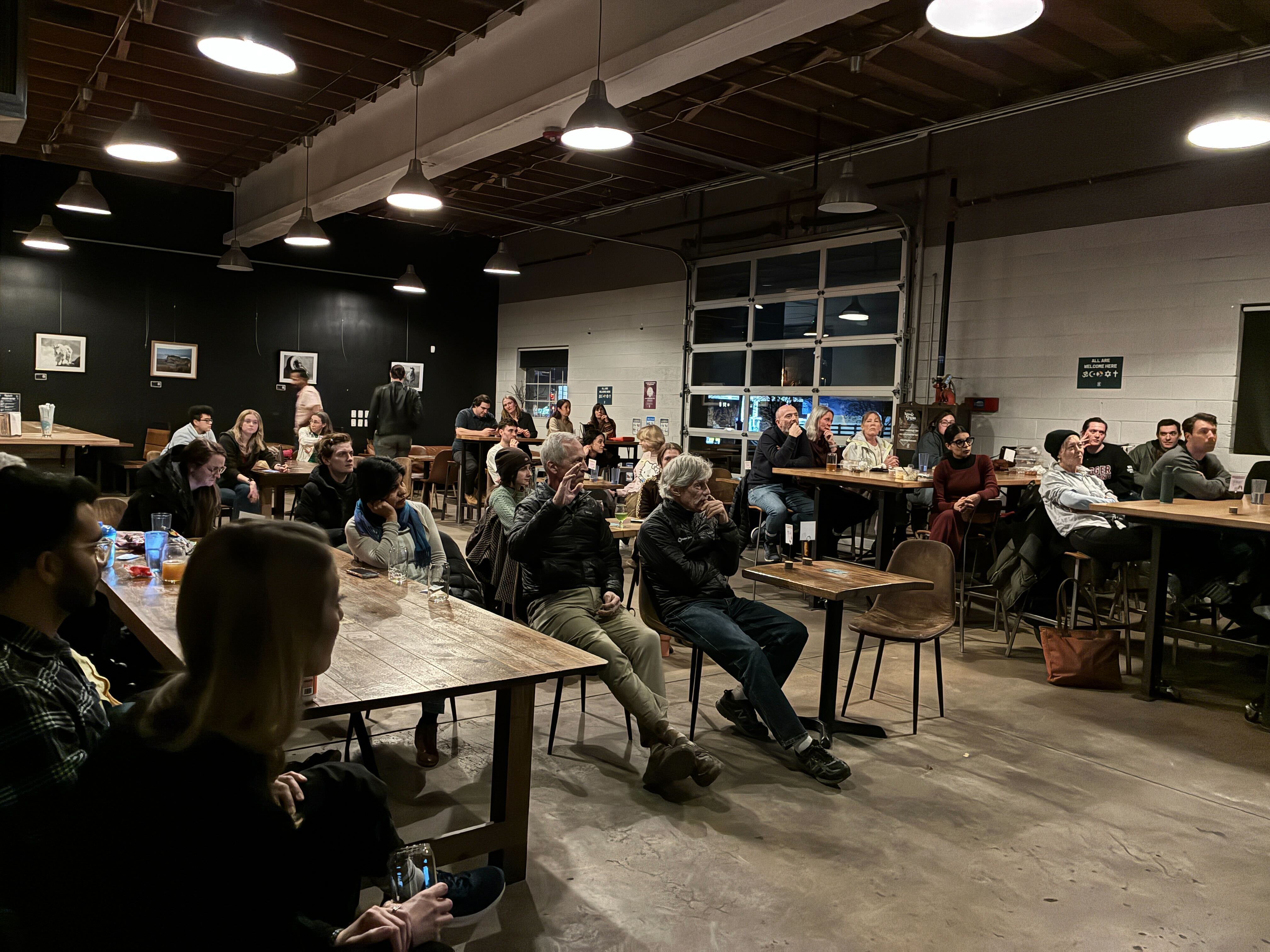
See Day of SlidesAs a student researcher at CU Boulder's Sustainability Research Initiative, I served as the organizer for the SRI AI & Data Centers Sustainability Workshop—a full-day, transdisciplinary event bringing together researchers from across CU Boulder to examine the sustainability challenges posed by the rapid expansion of AI systems and data centers.
Held on December 8, 2025 at the CU Recreation Center, the workshop ran from 8:30 AM to 4:30 PM and was the first event of its kind for the newly established SRI. I was responsible for managing the end-to-end logistics of the event. This included recruiting and communicating with two keynote speakers—Dr. Esther Rolf, Assistant Professor of Computer Science at CU Boulder, and Stacy Tellinghuisen, Deputy Director of Policy Development at Western Resource Advocates—as well as coordinating 23 lightning talks from CU researchers across disciplines, collecting and organizing all presentation slides, and ensuring speakers were prepared and aligned on format.
Beyond speaker coordination, I supported the event with venue logistics, organized catered breakfast and lunch in collaboration with the SRI team, and facilitated a structured day of programming that included keynote sessions, two rounds of lightning talks, and a World Café ideation session designed to surface research synergies and seed working groups around shared sustainability challenges.
The workshop reflected SRI's broader mission to raise the visibility of CU Boulder's sustainability expertise, connect researchers across silos, and position the university to respond to emerging funding opportunities at the intersection of AI, infrastructure, and environmental impact.
NurseWell at AdventHealth
Submitted: December 5, 2025
See ProjectDuring Fall 2025, our team (Caitlin Littlejohn, Robyn Marowitz, Sara Runkel) partnered with AdventHealth through the Social Impact Laboratory to address critical nurse retention challenges. Through comprehensive research—including 41 surveys, 4 in-depth interviews, and 3 stakeholder workshops—we discovered that 67% of nurses plan to leave within three years, with nearly half considering departure within six months.
Our statistical analysis revealed that 75.6% of retention variance could be explained by just four factors: having inspiring role models, feeling respected, department culture, and preceptor support. The key insight was that nurses need both peer support and administrative support to thrive—having one without the other leads to eventual departure.
In response, we designed the "Safety Net," a four-layered support system that makes it structurally impossible for new nurses to fall through the cracks. The program includes: (1) a three-month Buddy System pairing new nurses with compensated mentors for daily support, (2) standardized Charge Nurse Guidelines with mandatory check-ins and proactive intervention training, (3) an automated Heavy Shift Alert System integrated with Epic to deploy real-time resources when units become overwhelmed, and (4) mandatory 48-Hour Check-Ins after traumatic events to connect nurses with counseling before crisis escalates.
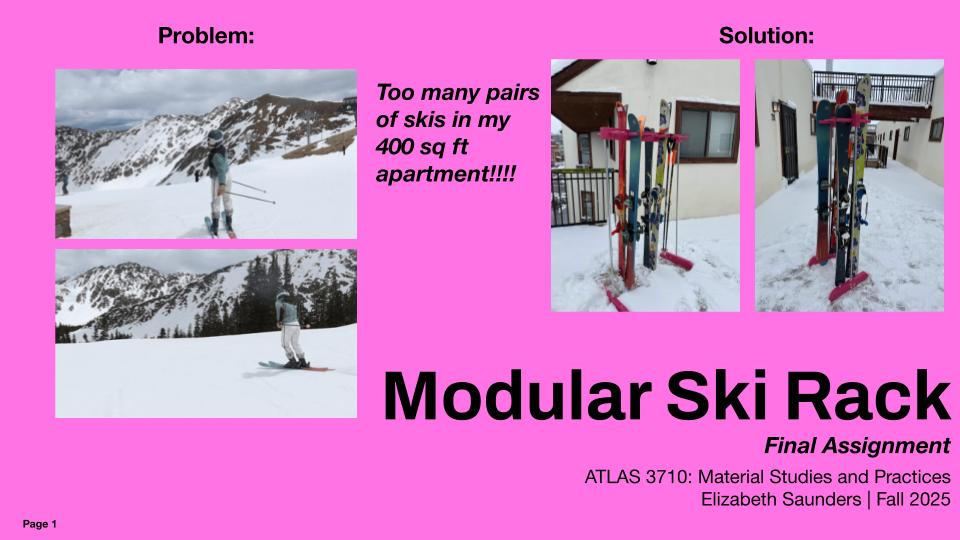
Modular Ski Rack
Submitted: December 5, 2025
See ProjectFor my final project in Professor Zack Jacobson-Weaver's ATLS 3710 Material Studies and Practice course, I combined aluminum tubing, Douglas fir, and cotton terry cloth to solve a problem I actually face: storing skis in rental housing without drilling into walls. Inspired by Muller Van Severen's Alltubes furniture collection, I designed a freestanding rack that uses tension and weight distribution instead of wall mounting, researching each material's origins from bauxite ore weathering in tropical regions to Douglas fir's native range across western North America.
The project pushed my metalworking skills in bending and welding aluminum, woodworking for curved ski cradles, and material integration across different media. When Zack joked and asked if I'd actually use this, the answer was obvious: I built it for myself—a piece that's both sculptural and practical, demonstrating the semester's accumulated skills while creating something genuinely useful for my life.
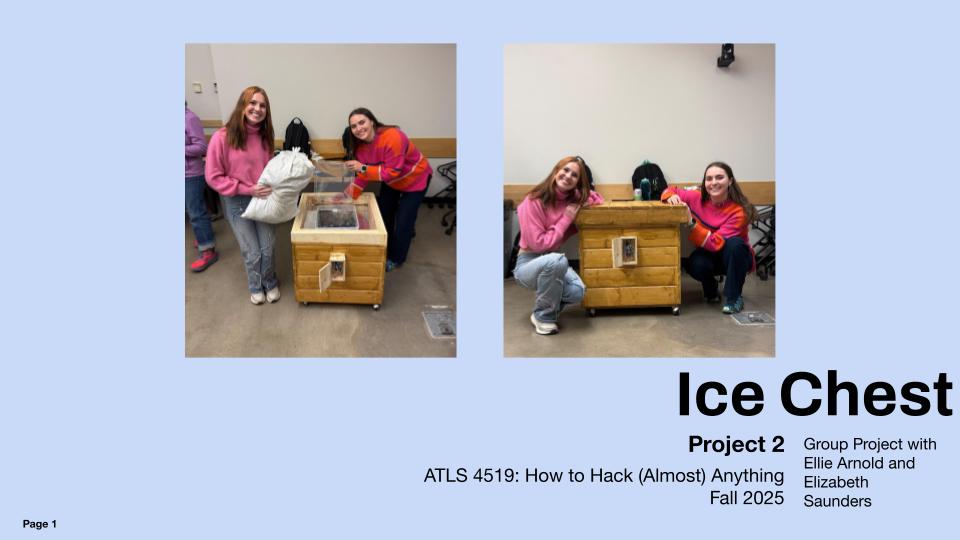
Ice Chest
Submitted: December 3, 2025
See ProjectGroup project with Ellie Arnold for ATLAS 4519 (Hacking the Apocalypse: Water) with Professor Zack Jacobson-Weaver. The premise of the semester-long research based course was to problem-solve for a future apocalyptic environment where water is scarce.
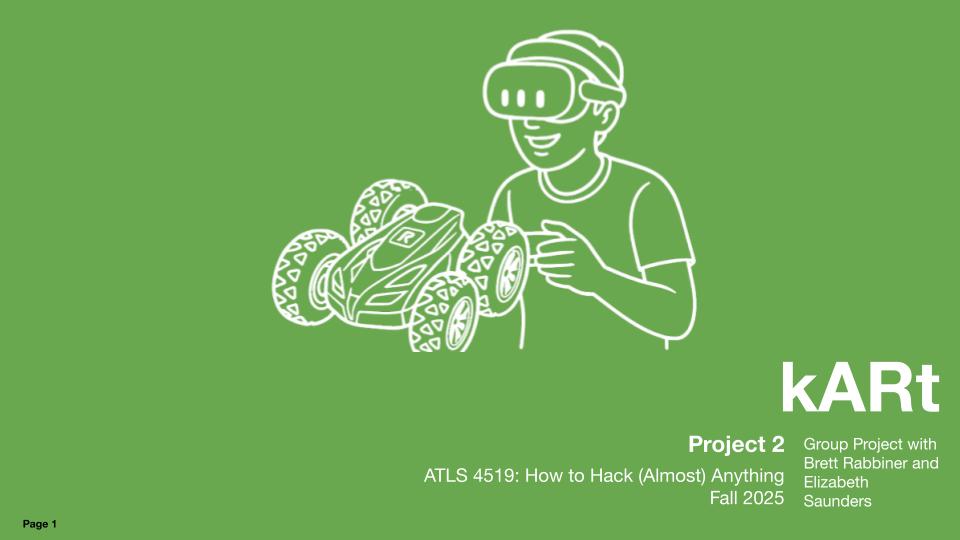
kARt
Submitted: December 2, 2025
See Project See VideoGroup project with Brett Rabbiner for Professor Ryo Suzuki's ATLAS 4519 (How to Hack (Almost) Everything) as a final project. This project originated from two major inspirations introduced in class: Mixed Reality development using the Meta Quest 3 and robotics experimentation with Sony Toio robots.
In Week 10, we explored How to Hack: Mixed Reality, experimenting with emerging AR/MR technologies such as the Meta Quest 3, Apple Vision Pro, WebXR, Hand Tracking, A-Frame, AR x Tangible interfaces, and Unity. The class demonstrated how immersive interfaces can transform user environments and create novel digital-physical interactions.
In Week 11, during How to Hack: Robots, we shifted to robotics and swarm interaction, working with the Sony Toio platform, reactive robotics, and RVO (Reciprocal Velocity Obstacles) algorithms. This highlighted how physical systems can become playful, interactive, and expressive.
Combining these inspirations, we were motivated to build something more creative, fun, and game-like, contrasting our previous highly practical project, Project 1: The ClueLess Closet. Inspired by telepresence systems and the entertainment value of Mario Kart, we set out to build a First-Person View (FPV) remote vehicle controlled through AR goggles—creating a hybrid system that merges robotics, mixed reality, and gamification.
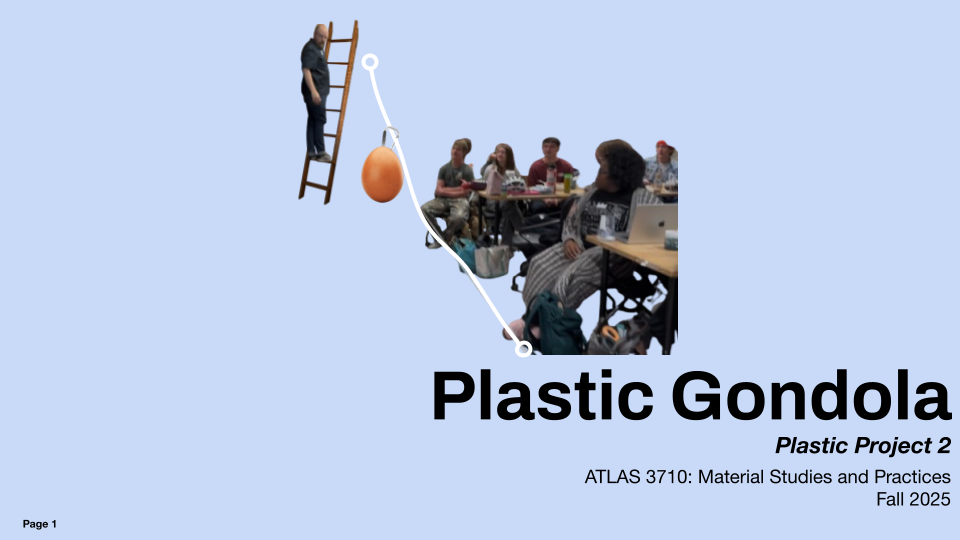
Plastic Gondola
Submitted: October 22, 2025
See ProjectAn individual design built for ATLAS 3710 (Material Studies and Practices) with Professor Zack Jacobson-Weaver.
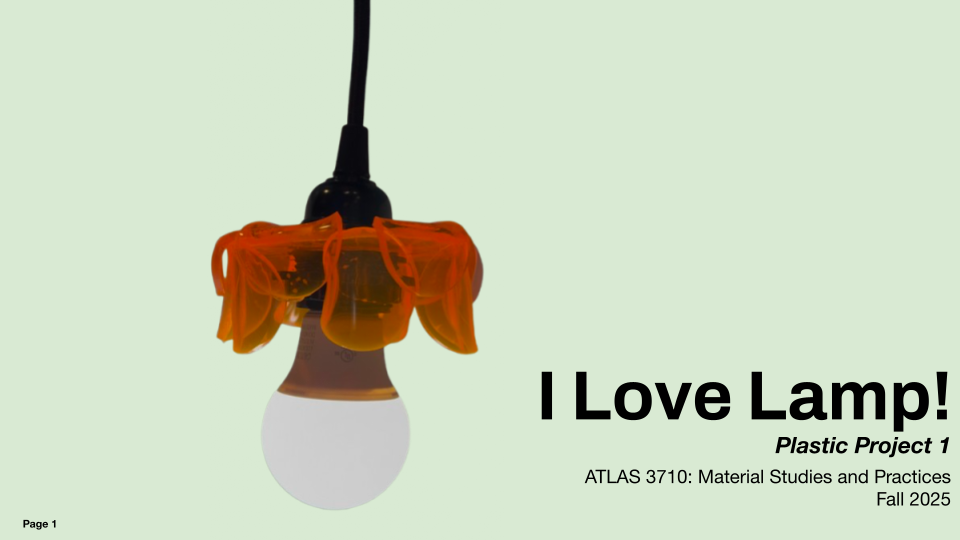
I Love Lamp!
Submitted: October 20, 2025
See ProjectAn individual design built for ATLAS 3710 (Material Studies and Practices) with Professor Zack Jacobson-Weaver.
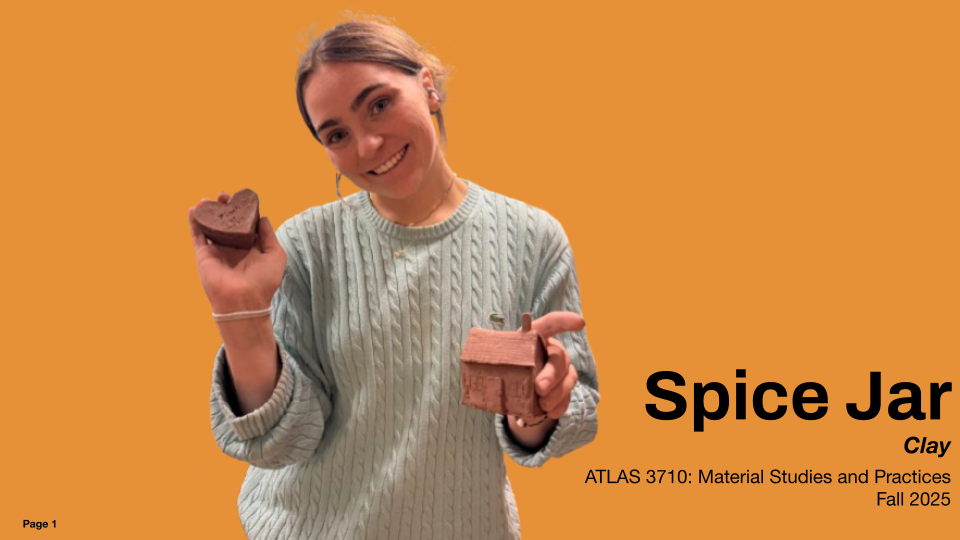
Spice Jar
Submitted: October 13, 2025
See ProjectAn individual design built for ATLAS 3710 (Material Studies and Practices) with Professor Zack Jacobson-Weaver.
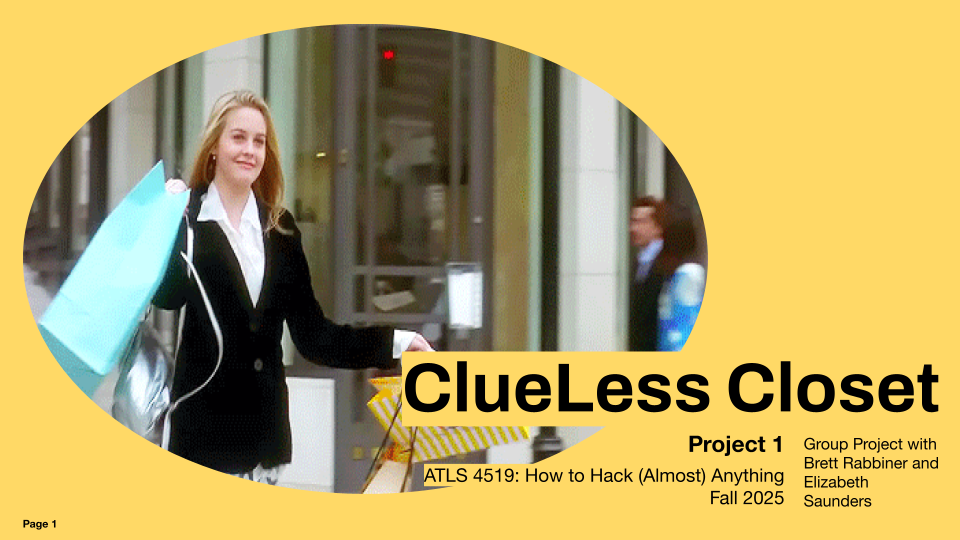
ClueLess Closet 2.0
Submitted: October 2025
See ProjectBuilt a browser-based wardrobe management system inspired by Cher's iconic computerized closet from Clueless for Professor Ryo Suzuki's ATLAS 4519 (How to Hack (Almost) Everything) as a midterm project. Partnering with Brett Rabbiner, I trained two custom TensorFlow.js models using Google Teachable Machine—one to classify clothing types (shirts, pants, dresses, outerwear) and another to identify style categories (casual, formal, athletic, minimalist, vintage)—processing over 2,000 unique training images from personal closets and retail sources.
The web application uses AI to automatically categorize uploaded clothing photos, integrates real-time weather APIs to suggest temperature-appropriate outfits, and generates coordinated outfit combinations through smart-matching algorithms that evaluate color coordination and style compatibility. All data is stored locally in the browser using localStorage, ensuring complete privacy without external servers.
This project evolved from my previous RFID-based closet tracking system (Spring 2025) by streamlining the digital cataloging process—reducing weeks of manual entry to minutes of batch uploads with AI doing the heavy lifting.
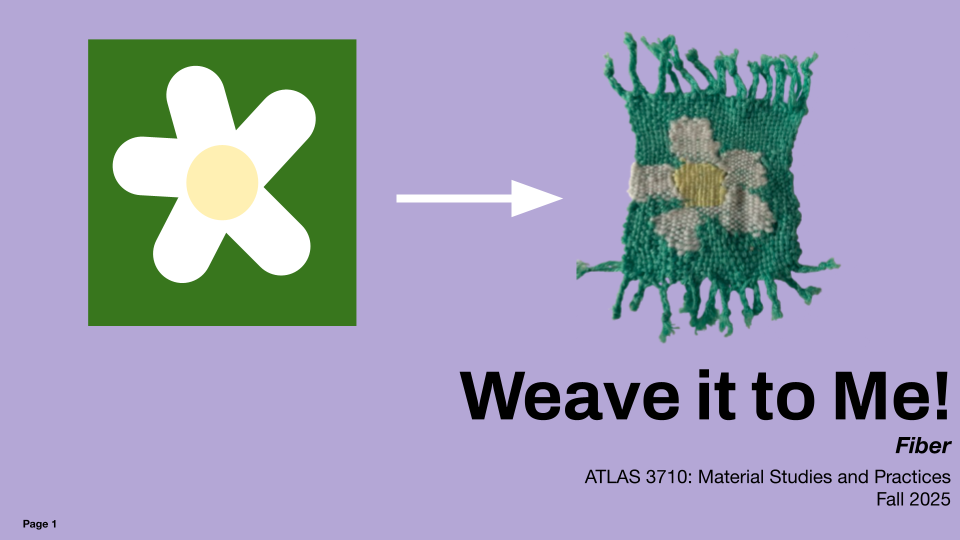
Weave it to Me!
Submitted: September 24, 2025
See ProjectAn individual design built for ATLAS 3710 (Material Studies and Practices) with Professor Zack Jacobson-Weaver.
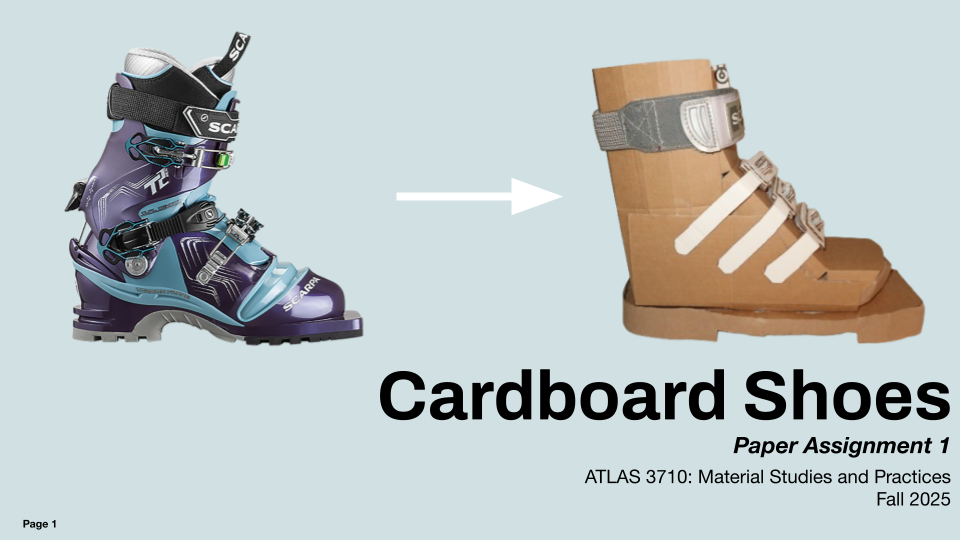
Cardboard Shoes
Submitted: September 16, 2025
See ProjectA weekend, individual design built for ATLAS 3710 (Material Studies and Practices) with Professor Zack Jacobson-Weaver. Built a pair of SCARPA 75 mm tele boots - exploring the intersection of traditional boot making craftsmanship and modern material engineering through hands-on construction, revealing how material properties, ergonomic considerations, and manufacturing techniques converge to create high-performance alpine equipment that balances durability, functionality, and user comfort.
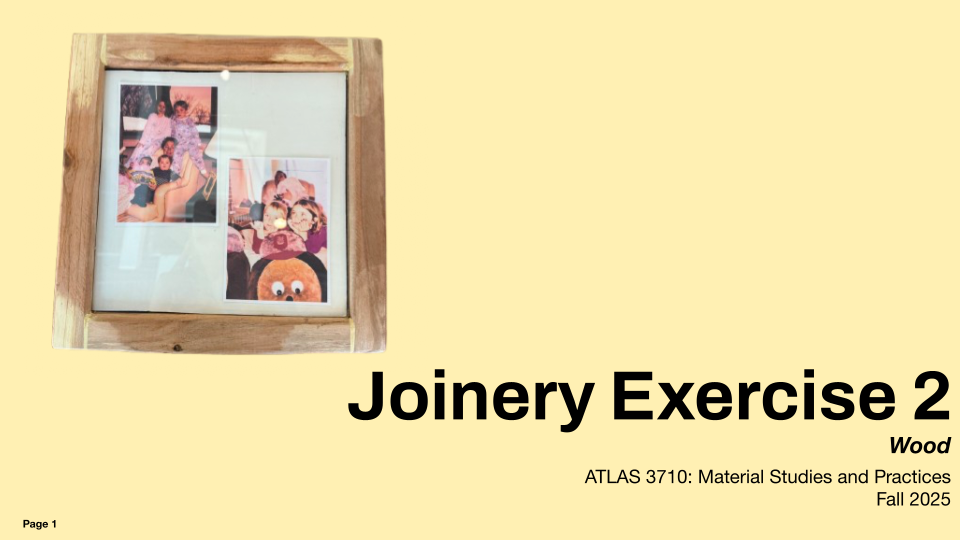
Joinery Exercise 2
Submitted: September 8, 2025
See ProjectAn individual design built for ATLAS 3710 (Material Studies and Practices) with Professor Zack Jacobson-Weaver.
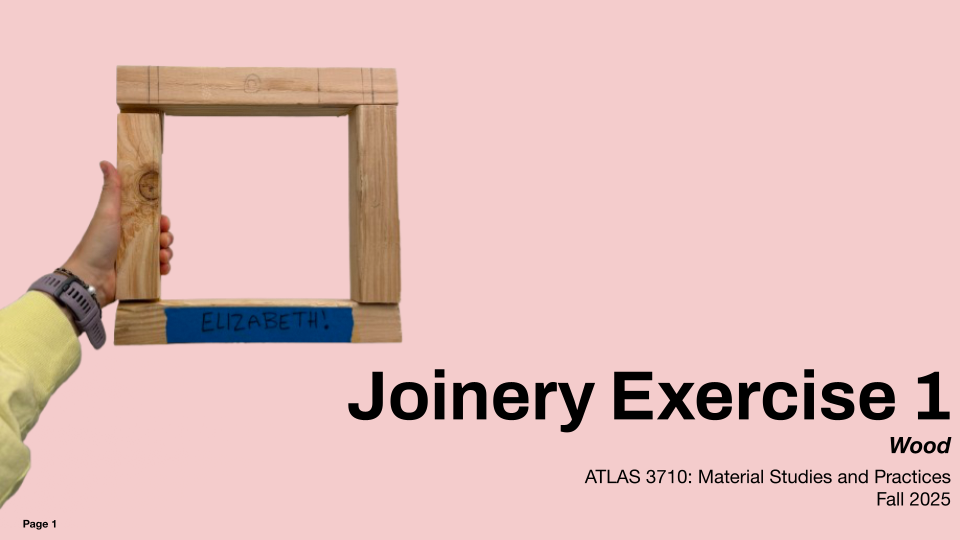
Joinery Exercise 1
Submitted: September 3, 2025
See ProjectAn individual design built for ATLAS 3710 (Material Studies and Practices) with Professor Zack Jacobson-Weaver.

Grad Student Researcher
Research Concluded: May 2025
Worked as a graduate student researcher under the mentorship of PhD student Josh Myers-Dean and Professor Al Bovik through the University of Colorado, Boulder's Department of Electrical, Computer, and Energy Engineering. Our research focused on evaluating the perceptual quality of lipreading videos for the deaf and hard-of-hearing community, in partnership with the National Telecommunications and Information Administration (NTIA). This project required conducting user studies to assess and improve video content accessibility. This work was directly aimed at improving the visual quality and effectiveness of lipreading videos, ensuring they met the needs of individuals in the deaf and hard-of-hearing community. Additionally, this research supported responsible energy consumption for a growing tech and media industry.
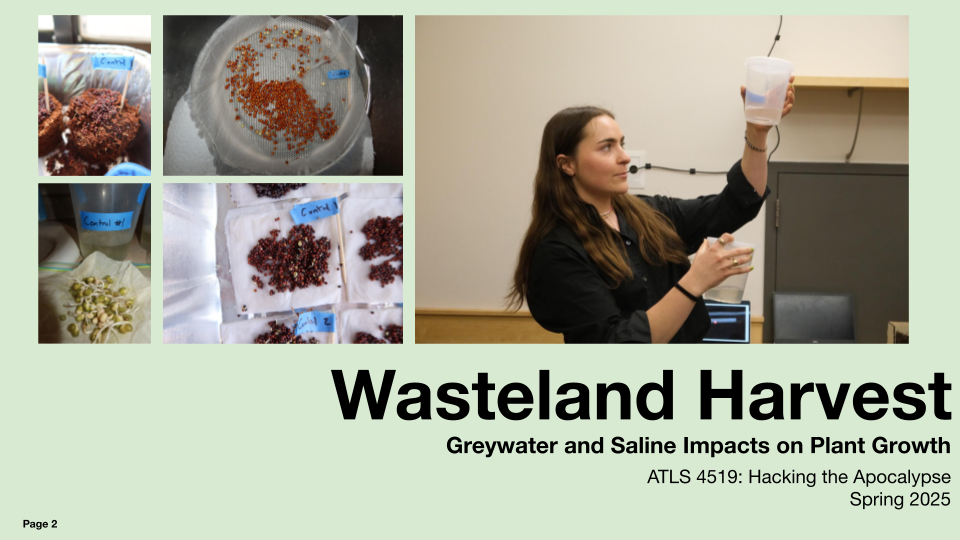
Wasteland Harvest
Submitted: May 1st, 2025
See ProjectAn individual research project for ATLAS 4519 (Hacking the Apocalypse: Water) with Professor Zack Jacobson-Weaver. The premise of the semester-long research based course was to problem-solve for a future apocalyptic environment where water is scarce. Throughout the semester, I led four experiments sprouting mung beans, broccoli, and radish using various saline amounts and different contaminates to study the effects of saline and grey water on plant growth. Ultimately, I sought to understand how to recycle water for agricultural demands in a future apocalyptic world.
Interviewed by ATLAS | Interviewed by CBS Denver
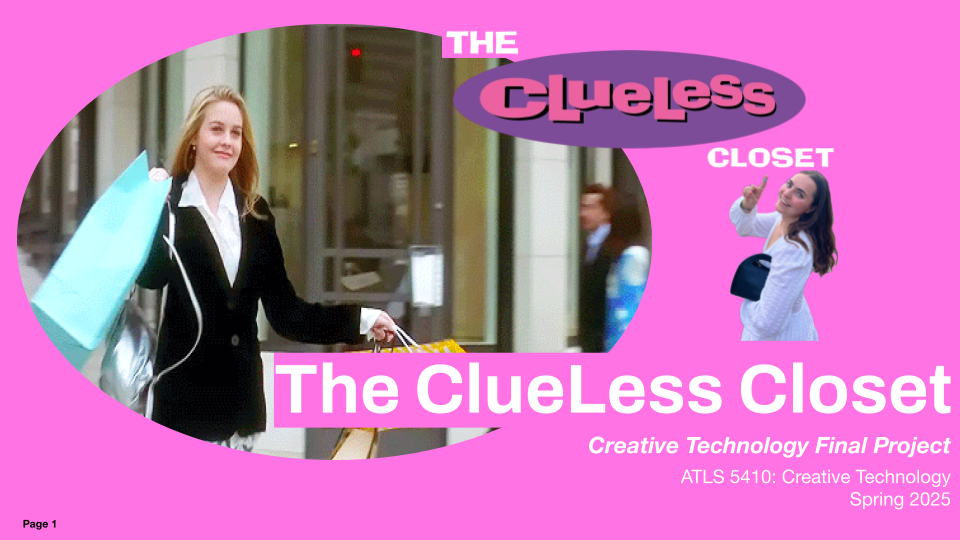
ClueLess Closet 1.0
Submitted: May 2025
See ProjectAn individual design project for ATLAS 5410 (Creative Technology) with Zack Jacobson-Weaver. Inspired by Cher's closet recommendation and organization system from the movie, ClueLess, my installation is installed in my closet and uses RFID tags and a sensor to monitor what is in/out of my closet. Depending what is in my closet, its wear count, what looks good together, and the weather outside of my apartment, I am given a recommended outfit posted to my associated HTML site for the project (or, recommended top, bottom, and outer wear). Over time, I have access to this data of what I am wearing vs. not so I can better keep my closet organized by removing clothes that are not being worn.
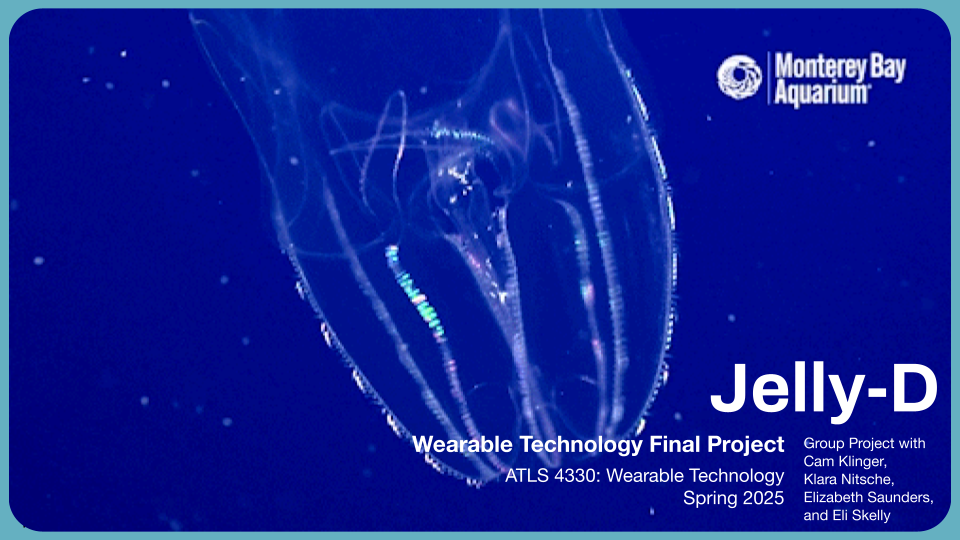
Jelly-D
Submitted: May 2025
See ProjectA class group project for ATLAS 4330 (Wearable Technology) with Dr. Shaz Zamore. The project is a wearable art piece that mimics the appearance and light-reflecting properties of comb jellyfish. The device replicates how these marine creatures naturally reflect light from their comb-like structures as they move. The primary target market is avant-garde and couture fashion, particularly inspired by rave culture. With a 7-hour battery life, it's designed as high-end festival wear that bridges fashion and biology. The Jelly-D bridges art, fashion, biology, and technology in an innovative way to spark conversations about marine life and the remarkable adaptations of our ocean ecosystems; demonstrating how nature's designs can inspire wearable art that makes marine biodiversity tangible and fascinating for new audiences.
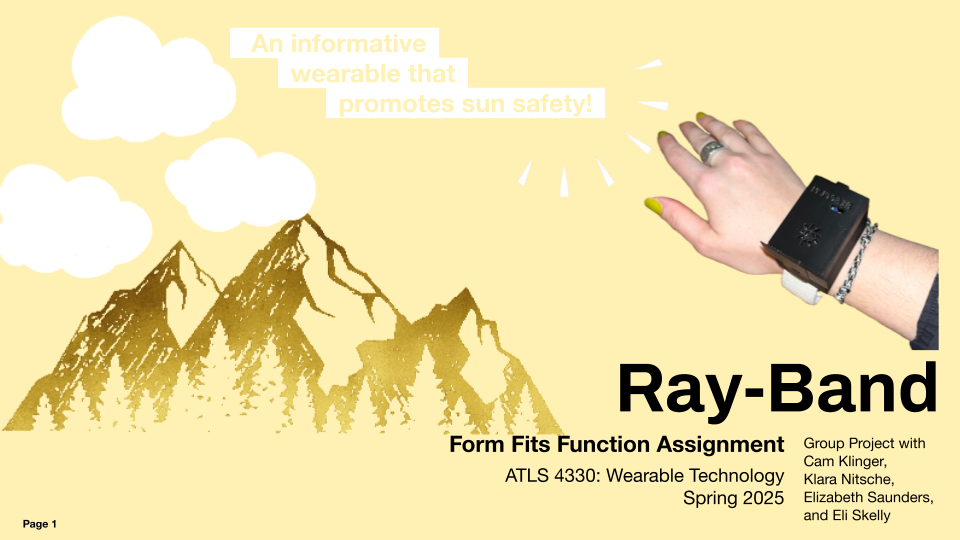
Ray-Band
Submitted: April 2025
See ProjectA class group project for ATLAS 4330 (Wearable Technology) with Dr. Shaz Zamore. The Ray-Band functions as a smart wearable device designed to enhance sun safety for outdoor enthusiasts by providing real-time UV index alerts and timed sunscreen reminders, ensuring that users can make informed decisions about sun exposure and maintain skin health during their outdoor activities.
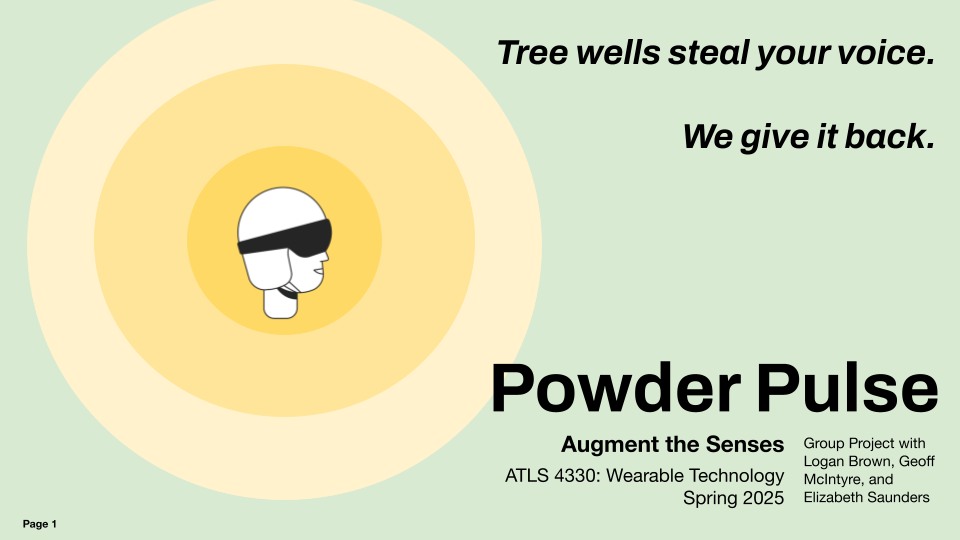
Powder Pulse
Submitted: March 2025
See ProjectA class group project for ATLAS 4330 (Wearable Technology) with Dr. Shaz Zamore. Inspired by recent deaths of skiers from getting stuck in tree wells, built a beacon for skiers to install onto and into their helmets. The beacon tracks the user's pulse ox data. If the user's pulse ox drops below the threshold and the user stops moving, the beacon goes off, sending a blaring alarm to alert others that there is a skier who has a low pulse ox and is not moving. Ultimately, the design hopes to keep skiers safe by getting them immediate attention when they lose their voice under the snow.
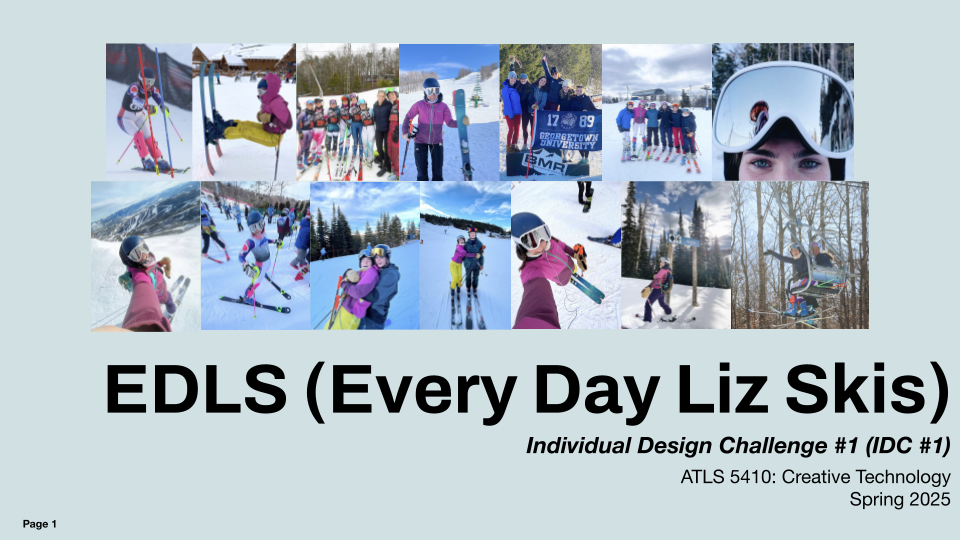
Ski Recommendation System
Submitted: March 2025
See ProjectAn individual design project for ATLAS 5410 (Creative Technology) with Zack Jacobson-Weaver where the class was asked to solve our personal pet peeves. For me, my biggest pet peeve is my own laziness in checking weather reports or ski resorts websites to find the best snow for a ski day or even what type of skis I should wear. My installation scrapes the Epic and Ikon resort websites along with weather data to tell me which pair of skis I should ski on and which resort I should ski at to guarantee a great ski day.
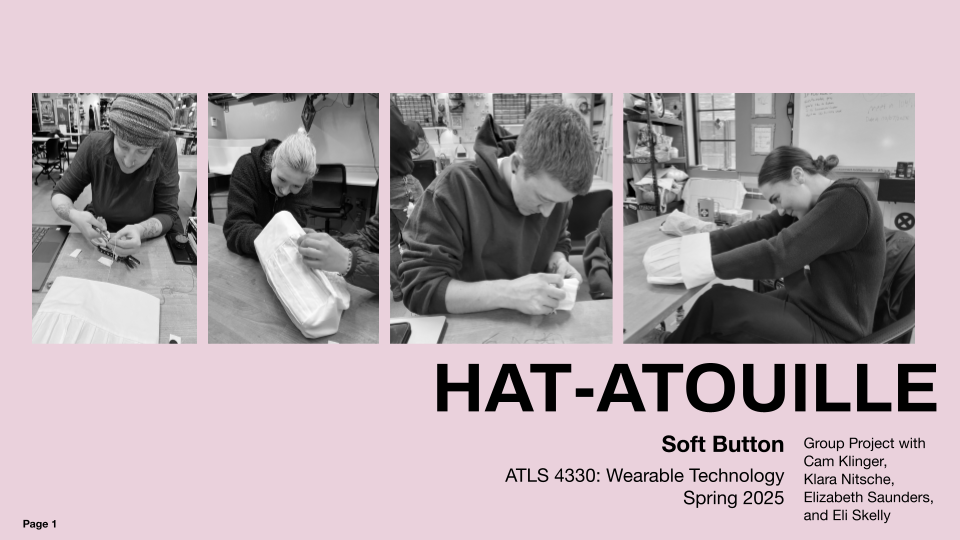
HAT-ATOUILLE
Submitted: February 2025
See ProjectA class group project for ATLAS 4330 (Wearable Technology) with Dr. Shaz Zamore. An introductory project for wearable technology to learn how to create a soft button. Alongside my group, created and designed a chef's hat inspired by Alfredo Linguini's chef hat that Remy would hide in from the Disney movie, Ratatouille. Using conductive materials, the LEDs inside the hat turn on when the circuit is closed, (or, someone is wearing the hat as their skin is the conductive element that closes the circuit; thus, a button!). When the LEDs are on, it casts a shadow of the rat cutout imitating the Ratatouille look. This introductory project taught us to merge technical concepts with storytelling, demonstrating how even fundamental circuit principles can create magical, interactive experiences.
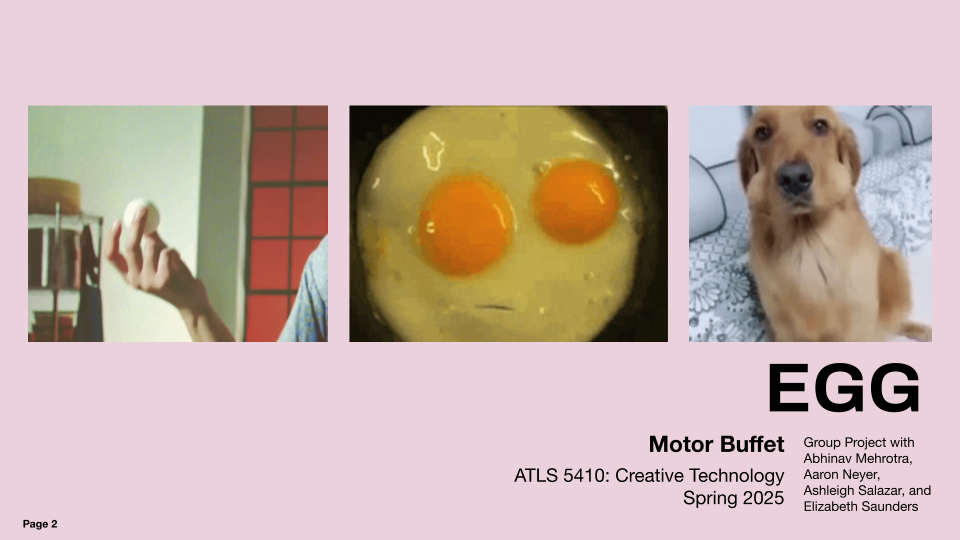
Motor Buffet Egg
Submitted: February 2025
See ProjectGroup project with Abhinav Mehrotra, Aaron Neyer, and Ashleigh Salazar for ATLAS 5410 (Creative Technology) with Zack Jacobson-Weaver.
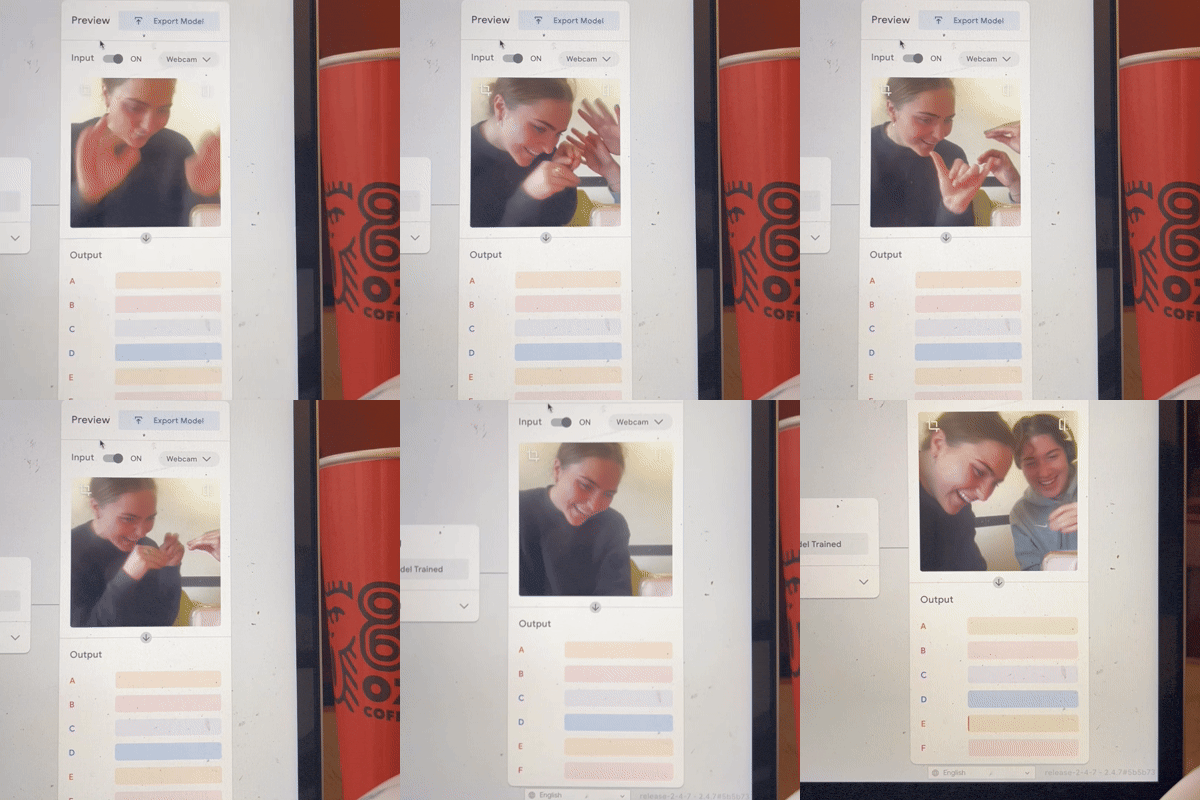
Signing in Binary
Submitted December 16, 2024
See Project See Code See DemoFinal project for Professor Justin Gitlin's ATLAS 5660: Creative Code, built to help people learn American Sign Language by recognizing hand shapes in real time. Using Google's Teachable Machine and ml5.js inside p5.js, I trained an image-classification model on a live webcam feed and built it into a three-level learning tool: an easy mode recognizing the hand shapes for binary digits 0 and 1 with instant visual feedback, a medium mode that generates a random letter for the user to sign and confirms a match, and a hard mode where the user signs a full binary sequence that the program captures and decodes back into text. The interface includes camera and left/right-hand toggles, reference images for each hand shape, and color-coded feedback to reinforce correct signing.
The original plan was to recognize the full 26-letter ASL alphabet, but Teachable Machine's accuracy held up poorly even after testing with friends to broaden the training data. Researching how others had approached ASL recognition with TensorFlow made clear the full alphabet was more a machine-learning engineering problem than a creative-coding one. I rescoped to two cases — binary digits 0 and 1 — a simplification inspired by a TikTok about binary-to-ASCII decoding, which showed the same point about accessible sign recognition could be made with two hand shapes instead of twenty-six.
The project led somewhere unexpected: after sharing it in a class presentation, I was connected to an independent-study opportunity and am now working as a graduate student researcher under PhD student Josh Myers-Dean and Professor Al Bovik in CU Boulder's Department of Computer Science, evaluating the perceptual quality of lipreading videos for the deaf and hard-of-hearing community in partnership with the National Telecommunications and Information Administration (NTIA) — work rooted in the same commitment to inclusivity this project started with. I plan to return to this project with what I learn there, making it more inclusive as I extend it from binary digits to the full ASL alphabet.
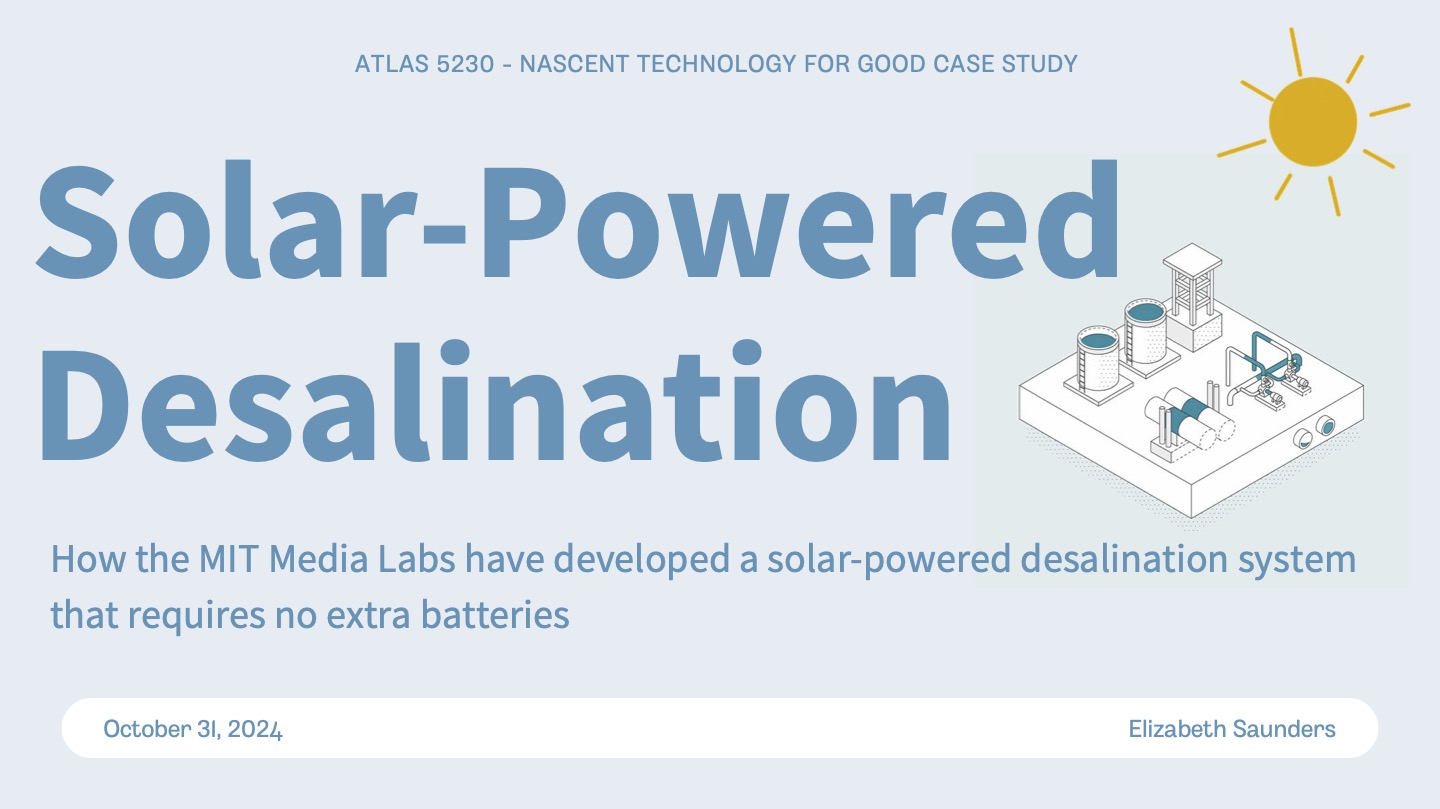
Solar Powered Desalination
Presented: October 31st, 2024
See PresentationAs part of my Technology for Social Impact course at the ATLAS Institute (Fall 2024, taught by Denise Powell), I researched advancements in solar-powered desalination and interviewed an MIT Media Lab researcher, Jon Bessette, to better understand how this emerging technology can address the global water crisis. My case study explored MIT's groundbreaking system that uses solar power without the need for batteries or grid access—offering scalable, sustainable water solutions for underserved communities. This project deepened my interest in equitable infrastructure design and the role of innovation in climate resilience.
ESG Research
May 2023 - Aug 2024
I joined Trinity's Digital Solutions Team, led by Jason Schmitz, to leverage technology in streamlining environmental solutions, with a focus on tackling the complexities of Scope 1, 2, and 3 emissions. My role involves helping clients accurately measure, manage, and reduce both their direct (Scope 1) and indirect (Scopes 2 and 3) environmental impacts across their operations and supply chains.
Report on Georgetown's OTC
Submitted: May 6, 2024
See Presentation See PaperThis final research term paper for STIA 3375 "Science, Innovation, and Entrepreneurs" under Professor Charles Wessner at Georgetown University examines how Georgetown University's Office of Technology Commercialization responds to innovation challenges in the post-Gardasil era. Through comparative analysis and interviews with professors and department heads at peer institutions including Stanford, Columbia, and CU Boulder, I evaluated Georgetown's strategic transformation under new leadership, analyzing both quantitative metrics from AUTM licensing surveys and qualitative insights from interviews with university administrators and faculty researchers. The study reveals how Georgetown's historically successful tech transfer program—responsible for breakthrough innovations like the HPV vaccine Gardasil, Allegra, and CT scanner technology—faced sustainability challenges when key patents expired, leading to a 70% revenue decline. My research documents the university's strategic response, including new leadership appointments, mission statement development, cross-campus partnerships, and portfolio optimization efforts aimed at diversifying Georgetown's innovation ecosystem.
Undergraduate Senior Thesis
Submitted: May 1st, 2024
See Presentation See Paper Watch Thesis DefenseStudied "Technology for Social Impact and Sustainability" under the mentorship of Dr. William Hahn (Environmental Biology) and Dr. Mahendran Velauthapillai (Computer Science) and overseen by Dean Dr. Bernard Cook at Georgetown University's Interdisciplinary Studies program to research and design solutions that drive social change and sustainability.
This interdisciplinary research project is the culmination of my degree which I successfully defended on May 1st, 2024 to the Interdisciplinary Studies department at Georgetown. I combined primary interviews with mobile app developers, hands-on app development experience, and extensive literature review to investigate how technology can drive social change and sustainability through the United Nations Sustainable Development Goals. Drawing from diverse academic sources and real-world developer insights, the study demonstrated that mobile applications possess unique capabilities to collect data, connect communities, protect resources, and affect to create meaningful impact when strategically implemented.
The project's central contribution is the FIFO (First In, First Out) solution model—a framework that creatively adapts both culinary principles learned during my concurrent culinary school studies and computer science queue management concepts to argue that sustainable technology solutions work best as catalytic entry points rather than standalone fixes, requiring collaborative, community-based, and creative approaches to achieve lasting social and environmental change.
Wellfed Market
May 2021 - May 2024
See Video #1 See Video #2 See SLI PresentationBuilt a mobile iOS food-sharing platform to empower my college campus and beyond to mitigate food waste, alleviate hunger, reduce the environmental effects associated with food waste, and connect communities through food. The app connects users to excess food in their community in a reliable, safe, and secure way.
Wellfed Market is a food-sharing platform empowering consumers to mitigate the environmental effects of food waste, alleviate hunger, and connect communities through food. Ultimately, hoping to localize the food system of America. Wellfed Market is dedicated to those like my Nana: resourceful chefs who always bring an extra seat to the table. This app allowed me to partner with local non-profits, small businesses, student groups, incubators/accelerators, and government groups to help distribute and source local food.
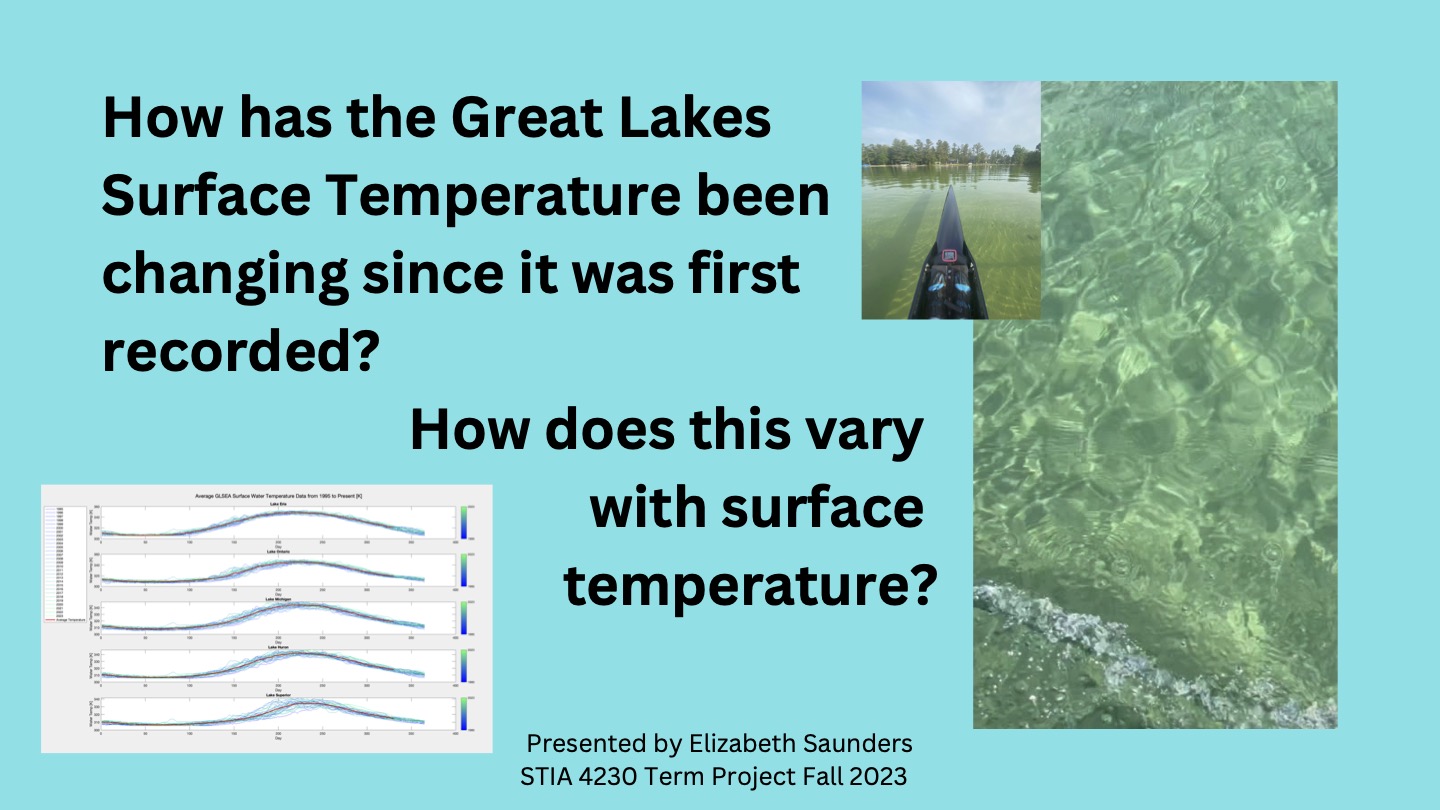
Great Lakes Surface Temps
Submitted: December 16, 2023
See Presentation See PaperThis final term project for STIA 4230 "Data Science for A Changing Climate" under Professor Megan Lickley at Georgetown University analyzed nearly three decades of Great Lakes surface water temperature data (1995-present) from NOAA CoastWatch alongside NASA GISS land surface temperature data to investigate climate resilience patterns across all five Great Lakes. Using temperature anomaly calculations and linear regression analysis comparing water and land temperatures from corresponding Great Lakes cities (Marquette MI, Prince Edward ONT, Traverse City MI, Alpena MI, and Erie PA), the study revealed four key findings: (1) remarkable consistency in Great Lakes water temperatures over time, with minimal deviation from long-term averages despite climate change concerns, (2) synchronized temperature variation patterns across all five lakes despite their geographic diversity in depth, topography, and regional conditions, (3) depth-dependent temperature stability, with deeper Lake Superior showing greater variability than shallow Lake Erie due to thermal inertia and mixing dynamics, and (4) confirmation that water holds energy longer than land, resulting in smaller temperature variations in aquatic systems compared to terrestrial environments.
3D Printing Food
Submitted: December 15, 2023
See Presentation See PaperThis research paper, completed for STIA 331 (Science, Technology & International Affairs) at Georgetown University under Professor Brian Toohey, explores the evolution of 3D printing technology from its origins in manufacturing to its emerging applications in food and organic material production. Through comprehensive interviews with three researchers at different career stages—graduate student Jack Kraynak (Temple University bioprinting research), postdoctoral fellow Dr. Jonathan Blutinger (Columbia University's Creative Machines Lab, funded by ReDefine Meat), and lab director Dr. Michael Rivera (CU Boulder's ATLAS Institute, NSF-funded)—the study reveals critical insights about the current state and future potential of organic 3D printing. Key findings include the dominance of international companies (rather than U.S. firms) in funding large-scale food printing innovations, the critical role of bioprinting as a foundation for both medical and food applications, significant sustainability challenges requiring energy-efficient solutions and alternative organic filaments, and the growing need for intentional, environmentally-conscious development practices.
CalcuSaver
2017 - May 2021
See Project See Award The project in the news See VideoBuilt a public safety iOS app at 15 with the help of an older classmate, Elijah Cobb. Inspired by being in an uncomfortable situation that I could not find my way out of, I learned how to program, build, and launch an app onto the iOS App Store as a means to help others discreetly get out of any situation.
CalcuSaver was created and designed to be used as an incognito way to send for help for whenever you feel like you are in an uncomfortable situation. 1. Manually type a phone number (to serve as your emergency contact) 2. Created a short numerical code (to serve as your emergency code) 3. Use the calculator's addition, subtraction, multiplication, or division functionalities (the calculator functions like a regular calculator) 4. Once the calculators output equals the emergency code, an immediate message will be sent to your choice of an emergency contact.
In 2017, my app won the Traverse City Central High School SciMaTech Project Competition. In 2018, my app won the Congressional App Challenge with Michigan's First Congressional Representative, Jack Bergman. I was invited to Washington D.C. and to share my project with congressional members at the Library of Congress. In 2019, my app won "Best Pitch" from TCNewTech during a pitch competition while also securing funding for the project.